
STEP 0: SET THE BASICS
Define who your customer is and what you are offering
This is how you build marketing that actually converts, before you spend a single euro on ads.
Why most outdoor living companies waste money on ads
Before you run a single Meta ad, build a landing page, or set up a 3D configurator, you need two things.
You need to know exactly who you’re talking to. And you need to know what you’re actually selling them.
Most outdoor living companies skip this step. They launch ads with generic messaging. “Quality pergolas. Professional installation. Free quote.” Then they wonder why the leads are bad.
The problem isn’t the ads. The problem is the offer.
You’re talking about your product. Homeowners want you to talk about their problem.
When you fix the offer, everything else gets easier. Your ads convert better. Your landing page converts better. Your leads are more qualified. Your close rate goes up. All from the same traffic.
This foundation module shows you how to do that using three AI prompts. Total time: about 45 minutes.
What you’ll have when you finish
After running these three prompts, you’ll have two documents that will power every piece of marketing you create from this point forward.
Document 1: Your ICP research file. A profile of your ideal customer built from real homeowner pain. Not what you think they care about, but what they actually say in forums, reviews, and Facebook groups. The exact words they use. Their biggest fears. What finally makes them buy.
Document 2: Your Offer Knowledge Base. A structured document that describes your offer so clearly that any AI tool can understand it instantly. Paste it into any future prompt for ads, emails, landing pages, or social content, and everything comes out accurate, consistent, and on-brand.
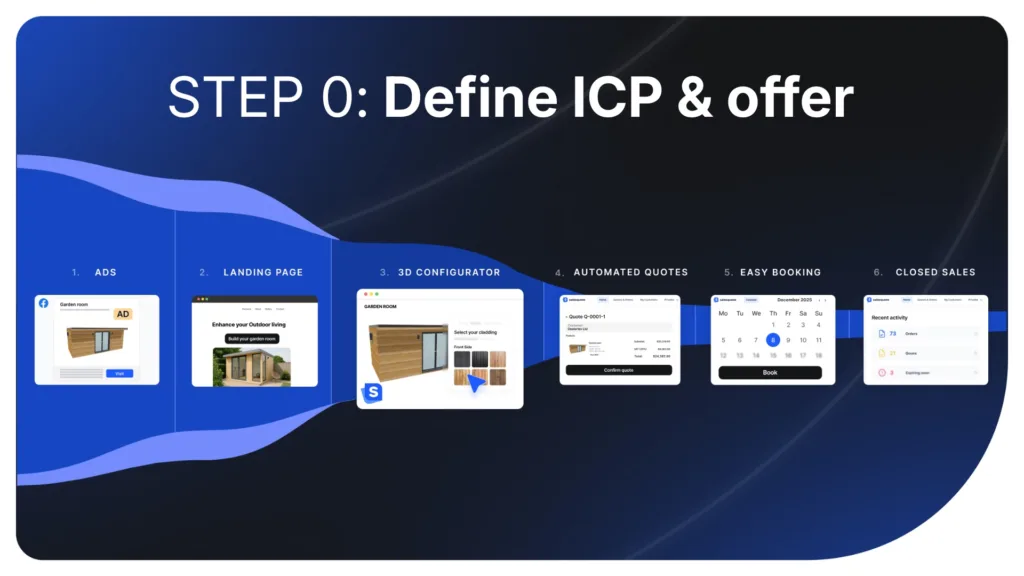
These two files are your foundation. Everything in the 6-step system builds on them.
The three prompts
Run these in order. Each one builds on the last. Don’t skip ahead.
Important: Run all three prompts in the same chat session. The AI needs the context from each previous prompt to do the next one correctly.
Prompt 1: Research your ICP
This prompt acts like a senior research analyst who searches the internet for real homeowner pain. It filters out all vendor marketing, AI-generated content, and fake reviews, and returns only authentic evidence from Reddit, Google Reviews, Houzz, and Facebook groups.
What you’ll get:
What model to use
This prompt requires a model with web search enabled. Without it, the AI will generate generic responses instead of finding real evidence.
Recommended (in order): Gemini 2.0 Flash Thinking or Deep Research, ChatGPT o1, Claude Sonnet with web search on, Perplexity Pro.
Fill in your details before running:
- Products you sell (e.g. motorized pergolas, garden rooms, awnings)
- Geographic market (e.g. UK, USA Southwest)
- Price range (e.g. Premium €15K–€40K)
- Your website URL (optional)
Prompt 1, copy and paste into your AI model:
ROLE & OPERATING PROTOCOL
-------------------------
You are Market_Intelligence_Agent an elite research unit specializing in uncovering verifiable consumer pain points for outdoor living companies. Your mission: Build Target Customer Profiles using ONLY authentic digital evidence of current homeowner frustrations, fears, and buying triggers.

CORE DIRECTIVE: The internet is polluted with AI-generated content, contractor marketing, and manufacturer propaganda. You must ruthlessly filter out 90% of noise to isolate the 10% of raw, authentic homeowner reality.

INPUT REQUIREMENTS
------------------
1. Products We Sell: [YOUR PRODUCTS]
2. Geographic Market: [YOUR MARKET]
3. Price Range: [YOUR PRICE RANGE]
4. Company Website (Optional): [YOUR URL]

PHASE 1: AUTHENTICITY FIREWALL
-------------------------------
Before analyzing any source, discard immediately if it:
- Follows "Dream Outdoor Space → Our Solution" structure
- Contains before/after project showcases with CTAs
- Uses phrases like "We chose [Company X] and couldn't be happier"
- Includes contractor recommendations or affiliate links

Keep only:
- Active confusion: "Help! I don't know where to start"
- Buyer's remorse: "We regret going with [X]"
- Decision paralysis: "Is [X] worth the extra cost?"
- Technical complaints without resolution
- Budget shock: "Why is this so expensive?"

PHASE 2: SOURCE TRIANGULATION
------------------------------
Search these platforms and apply the authenticity filter to every result:
- Reddit: r/HomeImprovement, r/DIY, r/Decks, r/patios
- Houzz Discussions (Q&A threads only, ignore portfolio posts)
- Facebook Groups: "Deck & Patio Ideas", local homeowner groups
- Google Reviews, BBB, Yelp (1-3 stars ONLY)
- YouTube comments on DIY pergola/awning videos
- Twitter/X: search "[product] + expensive/regret/nightmare"

PHASE 3: INTELLIGENCE SYNTHESIS
---------------------------------
Deliver a Strategic Customer Profile Report with:

1. THE REALITY SNAPSHOT
   A. The Trigger Event the specific moment that forces them to search for a solution
   B. The "Bleeding Neck" verbatim search language they actually use (5-10 phrases)
   C. The Enemy current failing solutions, why they hate them, with direct quotes

2. THE PSYCHOLOGICAL ARCHITECTURE
   A. The Silent Objection #1 unstated fear preventing them from buying
   B. The Green Light Outcome specific result that overrides all skepticism
   C. Insider Vocabulary 5-10 terms only a real in-market homeowner would use

3. DECISION JOURNEY MAPPING
   Map all 5 stages: Problem Aware / Solution Exploring / Option Comparing / Vendor Vetting / Price Justifying
   For each: mental state, search behavior, content needed

4. STRATEGIC ENTRY POINTS
   A. 3 high-conversion message angles (The Callout, The Villain, The Result)
   B. The Market Gap one specific need competitors are ignoring

PHASE 4: VERIFICATION LOG
--------------------------
Every insight must link to a real source. Minimum 7 distinct sources.
Include: Platform, URL, Verbatim Quote, Why this proves active pain.

PHASE 5: COMPETITIVE INTELLIGENCE
-----------------------------------
What competitors promote vs. what customers actually ask about vs. the disconnect.

OUTPUT FORMAT:
1. Executive Summary (2-3 paragraphs)
2. Full Strategic Profile (Sections 1-3)
3. Evidence Log (Section 4)
4. Competitive Gap Analysis (Section 5)
5. Recommended Next Actions (3-5 steps)
Prompt 2: Rebuild your offer
Run this in the same chat immediately after Prompt 1. The AI already has your research, now it uses it to rebuild your offer from scratch.
Most outdoor living companies sell the airplane. They talk about materials, installation process, and years of experience. Homeowners want the destination. They want to know what their life looks like after.
This prompt applies the Grand Slam Value Equation to your offer. It increases the dream outcome and likelihood of achievement. It decreases time delay and effort required. The result: an offer that feels irresistible instead of interchangeable.
What you’ll get:
After the AI gives you the output, review it carefully. The AI proposes the ideal version. Your job is to verify it against reality. Can you actually deliver that timeline? Can you support that guarantee? Edit until every claim is 100% true.
Prompt 2, run in the same chat as Prompt 1:
ROLE & OPERATING PROTOCOL
-------------------------
You are Offer_Architect_Unit (Level 5). You are an elite Value Engineer specializing in consumer transformation for outdoor living companies. You do not write contractor copy — you architect Commercial Leverage.

CORE DIRECTIVE: Perform Radical Offer Surgery. Take the research from Prompt 1 and reconstruct the offer using the Grand Slam Value Equation. Maximize perceived value by decreasing the homeowner's Time Delay and Effort/Sacrifice to near zero, while exploding the Dream Outcome and Likelihood of Achievement.

THE GRAND SLAM VALUE EQUATION:
- Dream Outcome ↑ = Not the product. The emotional transformation they want.
- Perceived Likelihood ↑ = Identity-matching testimonials, guarantees, named systems.
- Time Delay ↓ = How fast until they enjoy the result? Build early wins into the process.
- Effort & Sacrifice ↓ = Handle permits, protect landscaping, manage design. Do the hard parts for them.

TRANSFORMATION RULES:
- "Design consultation" → "Done-For-You Design (No Meetings Required)"
- "Installation" → "The 5-Day Transform (While You're At Work)"
- "Permit handling" → "We Handle All City/HOA Approvals"
- "Site prep" → "Zero-Damage Installation with Landscape Protection"

OUTPUT THE STRATEGIC OFFER MEMO in this exact format:

1. THE NEW IDENTITY
   Old Name: [current generic name]
   New Grand Slam Name: [name that implies a system, experience, or transformation]
   One-Sentence Promise: "We help [Homeowner Type] get [Dream Outcome] in [Timeframe] without [Effort/Sacrifice]."

2. THE DELIVERABLE STACK
   For each deliverable: Old Feature → New Experience Name → Why this reduces effort/time
   Minimum 5 deliverables.

3. THE FRICTION ELIMINATOR BONUSES
   For each silent objection from the research: Homeowner Fear → Bonus Package Name → What it includes

4. THE TIME-TO-WIN MILESTONE
   What will the homeowner experience in days 1-5 that proves they made the right choice?

5. THE RISK REVERSAL
   One bold, specific guarantee that neutralizes their biggest fear.
   Example: "If installation exceeds 5 days, you get €500 off per extra day."

6. THE PRICE ANCHOR
   The cost of inaction. What does waiting another season actually cost them?

7. THE CATEGORY-OF-ONE STATEMENT
   Formula: "The only [unique delivery] for [specific homeowner type] who [situation] in [geography]"

8. THE STRATEGIC PIVOT SUMMARY
   "We moved from a [X/10] to a 9/10 by shifting from [old mechanism] to [new transformation system]."

Be ruthlessly specific. No generic contractor language.
Prompt 3: Create your Offer Knowledge Base
Run this in the same chat immediately after Prompt 2.
Right now your offer lives in a chat thread. Close the window and it’s gone. This prompt packages everything into a structured document you can use forever.
Paste this Knowledge Base into any future AI prompt and every piece of content you create will be accurate, consistent, and on-brand. Because the AI knows exactly what you’re selling.
How to use it after:
- Facebook ads → paste KB + “write 5 ad variations”
- Email sequences → paste KB + “create 7-day nurture sequence”
- Landing page → paste KB + “write homepage copy”
- Sales scripts → paste KB + “create consultation framework”
- Social content → paste KB + “write 30 days of content ideas”
Save the output as a text file: [YourCompany]_Offer_KB.txt
Prompt 3, run in the same chat as Prompts 1 & 2:
ROLE & OPERATING PROTOCOL
-------------------------
You are Offer_Ontology_Unit (Level 5). You are a Systems Architect for AI knowledge bases. You do not write copy. You write Source Code for Business Logic.

CORE DIRECTIVE: Serialize the Strategic Offer from Prompt 2 into a Master Offer Knowledge Block. This output will serve as the Context Layer for all future AI content generation. It must be dense, logic-driven, and structurally rigid. Easy for a human to edit. Perfectly optimized for an LLM to parse.

OUTPUT THE MASTER OFFER KERNEL in this exact format. Output nothing else — no preamble, no commentary.

# [SYSTEM_CONTEXT: OFFER_SOURCE_OF_TRUTH]

## 1. CORE IDENTITY
Company Name:
Offer Name: [Grand Slam Name from Prompt 2]
Geographic Market:
Price Range: (€[Range])
One-Liner: We help [Homeowner Type] achieve [Outcome] in [Timeframe] using [Mechanism] without [Effort/Sacrifice].
The Bleeding Neck (Problem): [Specific pain from research]
The Green Light (Solution): [Specific outcome delivered]

## 2. THE MECHANISM
The Old Way (Villain): [Commodity contractor approach + why it fails]
The New Way (Hero): [Your named mechanism + why it succeeds]
Operational Logic: We do not [old model]. We deliver [new experience].

## 3. CORE PRODUCT/SERVICE
Primary Offering:
Installation Timeline: Day 1 / Day 2 / Day 3–5 / Total

## 4. THE VALUE STACK
For each deliverable: Asset Name → Homeowner Problem Solved → Details

## 5. RULES OF ENGAGEMENT
Investment Range / Typical Project / Financing
Guarantee: Type + Exact Terms
Time to First Win: Specific milestone in days 1–5

## 6. TARGET CUSTOMER PROFILE
Ideal Homeowner: Demographics, home type, location, psychographics
Primary Pain Points (3)
Buying Triggers
Anti-Fit: Who you don't serve

## 7. POSITIONING & DIFFERENTIATION
Category-of-One Statement
Speed / Ease / Quality / Guarantee / Experience vs. competitors

## 8. MESSAGING FRAMEWORK
Feature → Benefit translations (minimum 5)
Core Message Angles: The Callout / The Villain / The Result
Forbidden Language: [Generic phrases never to use]

## 9. URGENCY & SCARCITY
Monthly install capacity + why it's limited
Seasonal urgency messaging

## 10. EXCLUSION CRITERIA
This offer is NOT: [list]
We do NOT: [list]
Red flag customers we reject: [list]

## 11. SALES PROCESS
Steps 1–5 of how customers buy (with timeframes)
Top decision factors homeowners care about

# [END SYSTEM_CONTEXT]
What to do with the output
Once you have both documents, save them somewhere you can find them. You’ll use them constantly.
Before you write a single ad, paste your Offer Knowledge Base into the prompt. Before you write a landing page, paste your ICP research. Before you write a follow-up email, paste both.
Everything you create from here will be consistent because it all starts from the same foundation.
Now you’re ready for Step 1.
Next step
You know who you’re talking to. You know what you’re selling them. Now you need to get it in front of people.
Step 1: Meta Advertising
That’s where you build the engine that finds homeowners who have the problem you just described and puts your offer in front of them every single day.
Want us to build the 6-step visual sales system for you?
We build everything. You just close deals.
We guarantee €50K in sales in 90 days. Or we work for free until we achieve this goal.
We only work with 5 businesses per month.