
STEP 2: LANDING PAGE
Turn clicks into leads with a high-converting landing page
Learn how to build landing pages that convert 8% of visitors into qualified leads.
Why you need a landing page
You run ads. People click. Then what?
Most businesses send ad traffic to their homepage. Bad idea.
People land there and start looking around. They click “About Us” to learn more about the company. They browse the products page. They read testimonials. Then they get confused about what to do next and leave.
Your homepage is for browsing. Your landing page is for converting.
A landing page has one job: get people to take action. No navigation menu to distract them. No extra links pulling them in different directions. Just one clear path forward.
The example: Spolding & Sons landing page
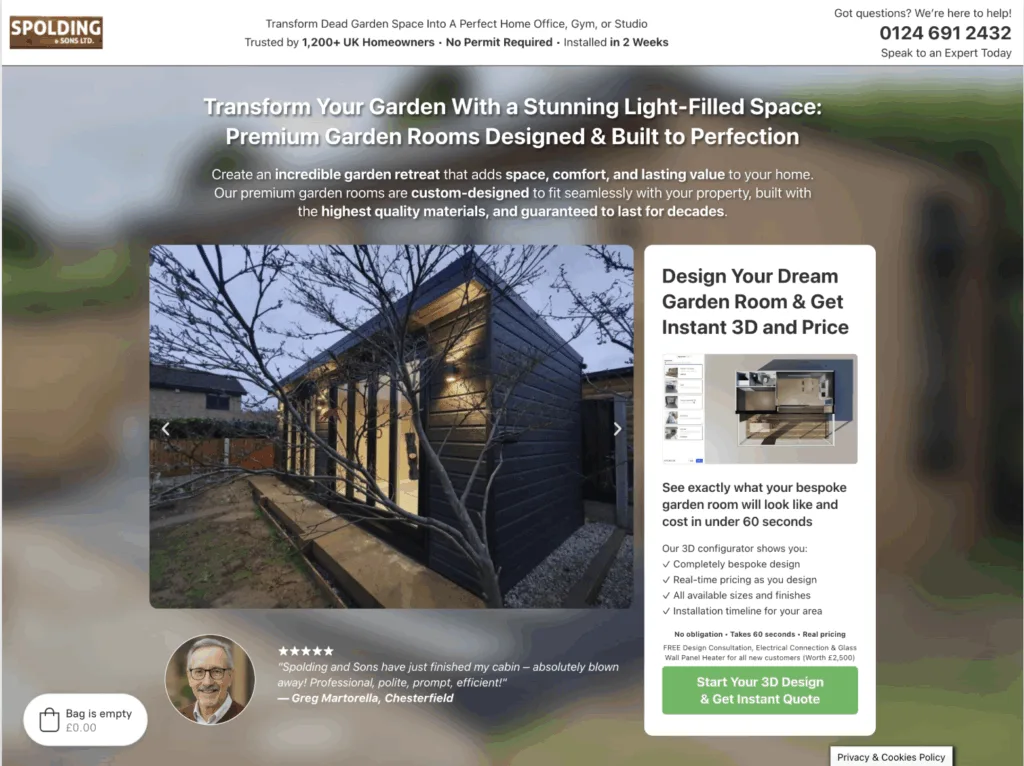
Here is an example of the simple landing page that generated 475 leads in 60 days and had a conversion rate of 8.17%.
Of 100 people who visited this page, 8 left their data. This is amazing.
Here are a few examples of landing pages for inspiration:
How to build your landing page
Here’s the structure that works. Follow this and you’ll convert visitors into leads.
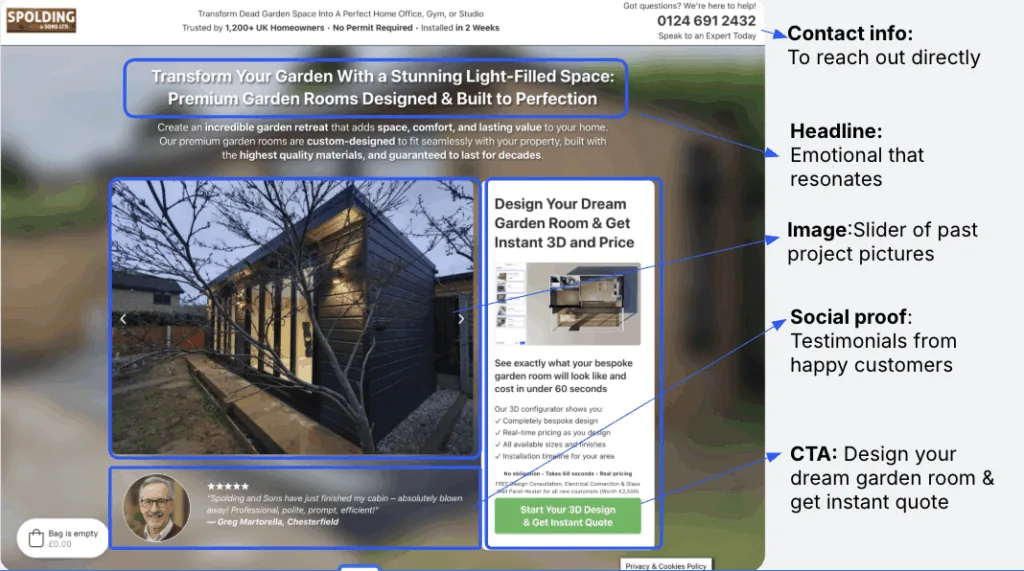
Put your phone number in the header. Some people still prefer calling instead of filling out forms. Make it easy for them to reach you directly.
A good example looks like this: “Got questions? We’re here to help! 0124 691 2432 – Speak to an Expert Today”
Your headline needs to match what the ad promised. If your ad said “Design your dream garden room in 60 seconds,” your landing page headline should say something similar.
Make it emotional. Talk about the transformation they want, not just the product features.
Spolding’s headline works because it speaks to what people actually want: “Transform Your Garden With a Stunning Light-Filled Space: Premium Garden Rooms Designed & Built to Perfection”
Notice how it talks about the result, not the process. People don’t buy garden rooms. They buy a beautiful space where they can work, relax, or spend time with family.
Add an image slider with three to five photos of past projects. Use real photos from actual customers. Not renders. Not stock images.
People can spot fake images instantly. When they see real projects, they can imagine how it would look in their own garden. This builds trust and makes the product feel real and achievable.
Customer testimonials work. Use reviews from Google, Trustpilot, or direct feedback from happy customers.
Include the customer’s real name, their photo if possible, and specific details about what they loved. Location helps too.
Here’s what works: “Spolding and Sons have just finished my cabin – absolutely blown away! Professional, polite, prompt, efficient!” — Greg Martinello, Chesterfield
Generic testimonials like “Great service!” don’t work. Specific praise with a real person’s name does.
One button. One action. Make it crystal clear what happens when they click.
Spolding’s CTA says: “Design Your Dream Garden Room & Get Instant 3D and Price”
Notice how it tells them exactly what they get. They’re not clicking to “learn more” or “contact us.” They’re clicking to design their own product and see the price. That’s specific. That’s actionable.
Your CTA should use action words like “Design,” “Get,” “See,” or “Start.” And it should promise immediate value like “Instant quote” or “In 60 seconds.”
The result
This landing page generated 475 leads over 60 days, with a 8.17% conversion rate.
That means for every 100 people who visited this page, 8 filled out the form to use the configurator. For a high-ticket product like garden rooms, that’s exceptional.
Most businesses get conversion rates between 1-3% on landing pages. This one gets 8%. That’s the difference between a good landing page and a great one.
What happens when they click the CTA?
When someone clicks your CTA button, show them a lead form before they can use the configurator.
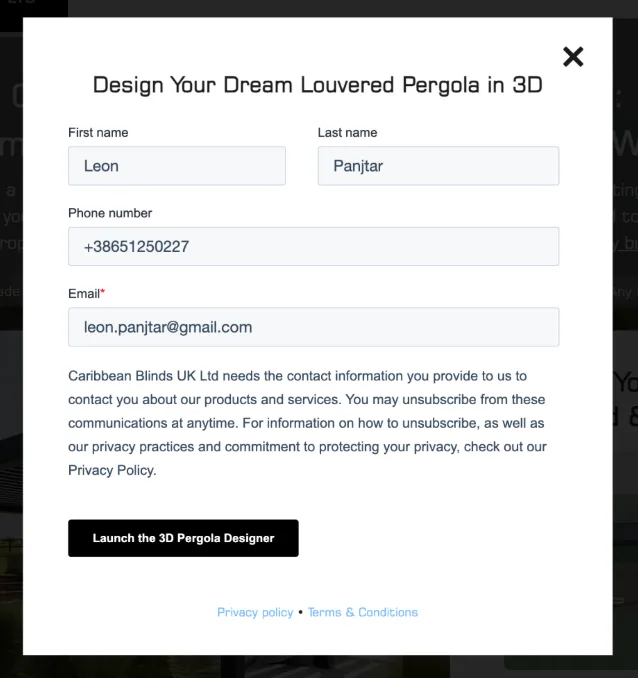
Ask for their name, email, and phone number. That’s it. Don’t ask for their address, their budget, their timeline, or anything else. Keep it simple.
Here’s why collecting contact info first is important.
First, it filters out people who aren’t serious. If someone won’t give you their email address to use a free design tool, they’re definitely not going to buy a £20,000 garden room. You just saved yourself time.
Second, their information automatically passes to the configurator. When they finish designing and want to request a quote, their name and email are already filled in. No double entry. This makes the next step easier and increases conversion by about two times.
Third, you capture the lead even if they don’t finish the design. If they start designing but don’t request a quote, you still have their contact information. You can follow up with them later.
The mistake to avoid
Don’t send ad traffic to your homepage. This is the biggest mistake outdoor living businesses make.
Here’s what happens when you do this. Someone clicks your ad for “Design your pergola in 60 seconds.” They land on your homepage. They see a navigation menu with links to Home, About, Products, Gallery, Testimonials, and Contact. They click “About Us” to learn about your company. Then they click “Products” to see what you offer. Then they browse your gallery. Then they’re not sure what to do next, so they leave.
Your homepage has too many options. Every extra link is another chance for people to get distracted and leave without taking action.
A landing page removes all distractions. One page. One purpose. One action. That’s how you convert.
Mobile optimization is critical. Most people clicking your ads are on their phones. Your landing page must look perfect on mobile. Test it yourself before you launch. If it doesn’t work on mobile, you’re losing 70% of your traffic.
Next step
Once they submit the lead form, they enter Step 3: The 3D Configurator.
That’s where they design their product, see it in 3D, play with all the options, and become highly engaged. We’ll cover that in the next lesson.
Want us to build the 6-step visual sales system for you?
We build everything. You just close deals.
We guarantee €50K in sales in 90 days. Or we work for free until we achieve this goal.
We only work with 5 businesses per month.