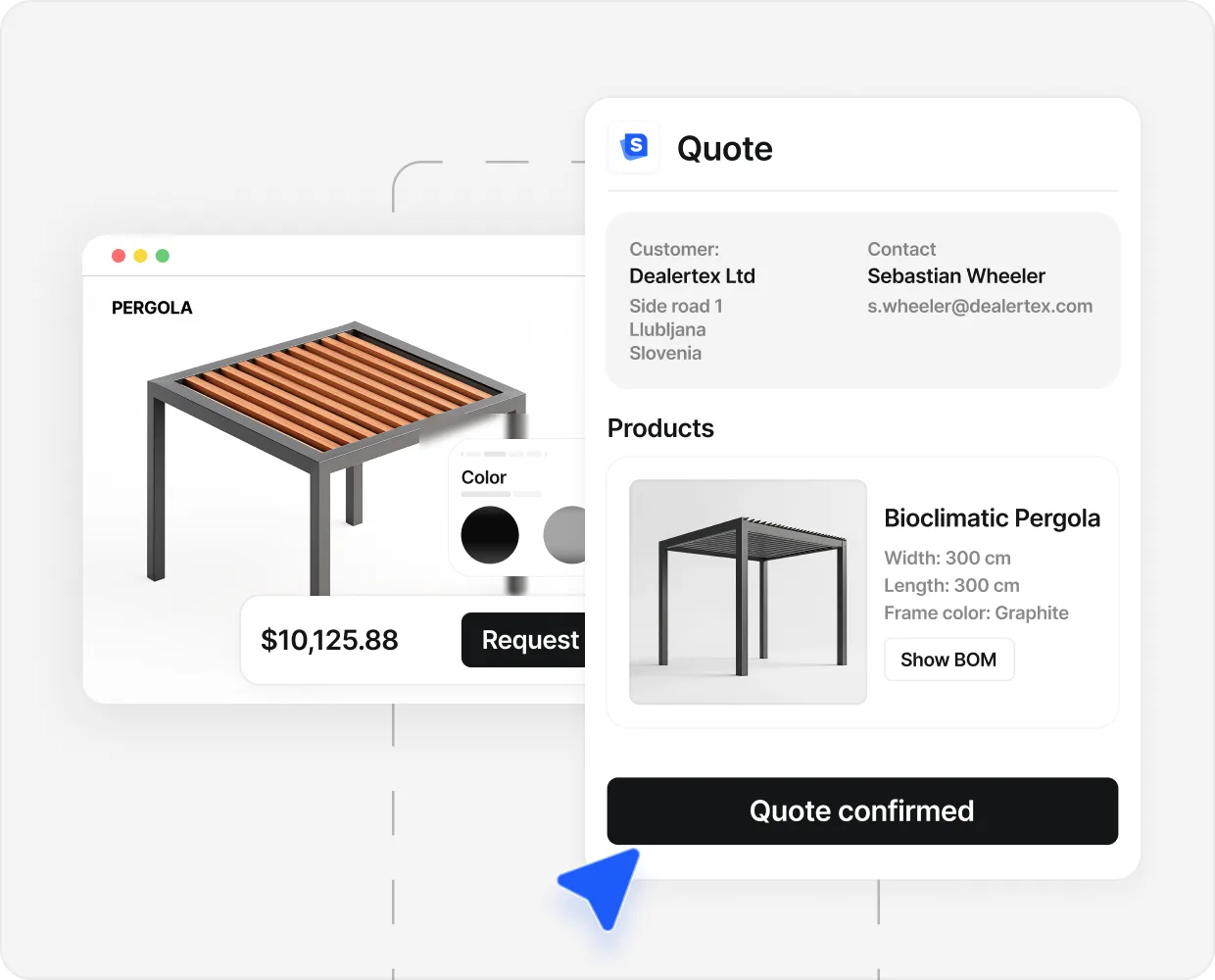


A pergola design tool is exactly what it sounds like: software the buyer opens in a browser, picks a size, roof, and finish, watches the pergola render in 3D, and gets a priced PDF in seconds. No drawing pad, no Sunday evening, no three-day wait for a number.
Most pergola sellers still draw the design themselves. The first call asks what the buyer wants. The second confirms it. The site visit measures it. The kitchen-table sketch turns the measurements into something the buyer can look at. The quote lands three days later, after the faster competitor has already sent theirs.
What a manual sketch really costs#
Most sellers do not have a real number for this. They have a feeling: “it takes a while.” The math is worse than the feeling.
Take a 4 by 5 metre louvred pergola. Fifteen minutes on the phone about size, posts, roof. A drive out to measure. A kitchen table, a printer, a calculator, a spreadsheet of supplier prices. A hand-sketched build, a calculated cost, a written PDF, an email, a wait.
Active time runs 30 to 60 minutes per quote, averaged across simple and complex ones. Cycle time, first call to quote in the inbox, runs 2 to 5 working days. Sellers running 25 quotes a month by hand, wondering why close rate sits at 5 percent, is a pattern we see often. The manual quoting errors breakdown covers what a single missed spec costs over a year.
We went from one or two pergola projects per month to 30 projects in 90 days. We started with no online presence at all. The configurator did the design work the team did not have time to do.
First to quote does not always win the deal, but sellers running five-day cycles lose more of them than they think.
What moves off the seller’s desk#
A pergola design tool draws the model parametrically, applies the configuration rules (which roof works with which post, which colour on which finish), prices it from your real cost rules, and hands the buyer a designed PDF that also lands in your CRM. The full breakdown of those four jobs, and what a good one versus a bad one looks like, lives in the pergola configurator guide.
What matters here is the effect on the week. Before: Monday opens with twenty contact-form lines, half of them price-shoppers, and a morning spent on voicemails and envelope-back sizes. Two buyers sign with the company that quoted them in 24 hours before you finish your third quote.
After: Monday opens with twelve designed PDFs already showing size, posts, roof, finish, and price. The CRM shows who spent twelve minutes designing and who bounced after picking a size. For most sellers I have worked with, that shift takes back roughly 20 hours a week, hours that used to go into quotes that never converted.
Evaluating a tool on a 30-minute demo#
The differences between vendors show up in minute six, not minute one. Four checks carry most of the decision.
One. Speed to live. A premade tool goes live in 1 to 10 days because the post systems, roof types, and rules already exist. A 3-to-6-month quote for a pergola means you are paying someone to learn the category.
Two. Built for pergolas, not “anything 3D.” A tool that already knows the category saves the entire onboarding loop a generic vendor makes you sit through.
Three. A real price on the demo. Ask the vendor to price a 4 by 5 metre louvred pergola with oak posts and lighting, live, on the public URL. “We’ll configure pricing later” means you are buying a viewer with no commerce.
Four. A designed PDF, not a screenshot. It should carry your logo, list the spec line by line, and read as a serious document, not a render with a number attached.
The full eight-point demo checklist, including mobile performance and the premium-positioning toggles, sits in the pergola configurator guide.
When it is not the right call#
Skip it for now if you are pre-revenue with no traffic, your average pergola sale is under 5,000 euros, every build is a fresh structural sketch with nothing repeatable, or you sell only through a marketplace with no website of your own to put the tool on.
If your average sale sits between 8,000 and 35,000 euros, where most outdoor living sellers in the UK, the Netherlands, Germany, France, Italy, the Nordics, and North America already operate, the math works: one extra closed deal pays for the tool and most of a year’s ad spend. The live pergola configurator gallery shows what a working tool looks like at that price point.
The buyer draws. The price renders. The PDF lands. The seller stops sketching pergolas at the kitchen table and starts closing the deals the tool surfaces. If you are still hand-drawing on a Sunday evening, the real cost is not the hour at the table. It is the buyers who never wait until Tuesday to find out what their build costs.
People also ask.
What is a pergola design tool?
Software that lets a homeowner, architect, or dealer design a pergola in the browser, see it rendered in 3D, and receive a real priced quote without picking up the phone. The buyer picks size, posts, roof, finish, and screens; the tool builds the model live and emits a PDF the seller can act on.
How is it different from CAD?
CAD is for the person designing the product. A pergola design tool is for the person buying one. CAD assumes a trained operator with a license and an hour to spare. A buyer-facing tool runs in any browser and produces a sales document, not an engineering file.
Do buyers really finish a design online?
Yes, when the tool is built for them. Pergola configurators routinely run 6 to 12 minute sessions with 30 to 40 percent of visitors completing a configured PDF. A buyer on your site at 9pm on a Sunday wants to keep going. A contact form makes them stop.
What does it cost and how fast can it launch?
Premade pergola design tools run a per-seller monthly subscription and can go live in 1 to 10 days. Generic 3D vendors quote €20,000 to €50,000 for setup and 3 to 6 months to launch, because they are learning the category on your project. Custom freelancer builds run €30,000 to €60,000 plus maintenance.
Will it replace my sales team?
No. It replaces the spec work. The sales team still closes, especially above 10,000 euros. What changes is the opening line: instead of 'what size were you thinking,' the rep opens with 'I see you designed a 4 by 5 metre louvred build on Thursday.'