

Why manual quoting errors are a structure problem, not a discipline problem
It is Friday afternoon in a workshop on the outskirts of a mid-sized European town. A senior engineer at a pergola manufacturer is recalculating a quote for the third time. The customer wants a 5 by 4 metre louvred pergola in anthracite with motorised screens and integrated LED lighting. The spreadsheet has been open since Tuesday. The price has changed twice because the steel supplier sent a revised rate sheet on Wednesday morning. The line for the motorised louvre system is missing because the configuration page in the catalogue was photocopied from the 2024 edition. The customer is on the phone, polite but cooling, asking when the quote will arrive. The engineer says it will be sent before the weekend. It will not be sent before the weekend. It will not be sent at all, because by Monday morning a competitor with a configurator will have already closed the deal.
That is not a story about a careless engineer. The engineer is good. The engineer has been doing this for fifteen years. The story is about what happens when you ask a competent person to hold a rule library that is, in any honest accounting, too large to hold. A customised pergola line might support 2,000 valid configurations, each with its own compatibility rules, pricing logic, and parts list. Working memory tops out at seven items, plus or minus two. The math does not work, and the errors that follow are not personal failings. They are structural.
We thought we had a discipline problem. We had a quality assurance process. We had a peer review. We had a senior engineer signing off every quote. The error rate sat at fifteen percent and would not move. The moment the rule library went into software, the rate fell to under one percent. The discipline was never the problem.
This post is a walk through what those errors actually are, why the four most common modes show up regardless of company size, what changes when the rule library lives in software, and the cases where staying manual is the right call. The numbers throughout come from public case studies of named teams who agreed to share their results.
The errors are in the structure, not the person#
The standard frame for a quoting mistake is that someone got something wrong. A salesperson mistyped a measurement. An engineer used last quarter’s price. A junior team member missed a component. Each of these is true, in the narrow sense that a human did the wrong thing. None of them is a useful explanation, because the cause sits one level deeper.
The cause is that the rule library is implicit. A made-to-order pergola line has thousands of valid combinations. The rules about which post systems support which roof spans, which finishes are available on which frames, which motors fit which louvre widths, and which accessories require which structural changes are not written down in a single place. They live in a senior engineer’s notebook, in a procurement manager’s spreadsheet, in a salesperson’s memory of last summer’s installations, in a manufacturer’s CAD library, and in three different versions of an Excel pricing sheet that nobody has fully synchronised since the supplier price change in March.
When the buyer asks for a quote, the team reconstructs the relevant slice of that rule library by hand, from those scattered sources, under deadline pressure. The reconstruction works most of the time. It fails predictably the rest of the time. The failure rate is roughly proportional to the complexity of the product line, the experience gap between team members, and the speed pressure on the response. A small line with three senior engineers and no urgency produces a low error rate. A complex line with mixed-experience staff and a competitive market produces a high one. The structure determines the floor.
This matters because almost every team starts with the wrong fix. They add quality assurance steps. They build a peer review process. They write a checklist. They retrain the team on the rules. Each of those interventions reduces the error rate by perhaps a third, because they reduce the rate at which a person makes a transcription mistake. None of them changes the underlying problem, which is that the rule library is in the wrong place. The error rate falls to a new floor and stops, because the floor is set by working memory, not by effort.
The four structural failure modes#
Four shapes account for almost every quoting error we have seen in customised-product lines. They show up in pergola dealerships, garden-room builders, carport manufacturers, fence companies, and modular-house makers. The names of the failures differ slightly by industry. The structures are the same.
Outdated pricing applied to current orders. Steel prices change. Aluminium prices change. Supplier discounts get renegotiated quarterly. A pricing spreadsheet is updated when the procurement team remembers to update it, which is not always within the week of the change. Quotes go out priced at the old number, the order is signed, the build runs at the new cost, and the margin disappears. The customer is unaffected. The accounting team finds the gap three months later, when the quarterly cost-of-goods review surfaces a fifteen percent variance against forecast.
Incompatible components paired in the same quote. A 6 metre roof span is offered with a 80mm post system, even though the structural rule says spans over 5 metres need 100mm. The motorised louvre system is paired with an undersized motor, because the salesperson did not check the cross-reference table. The drainage channel is sized for a 4 metre run and gets specified for a 5 metre one. The installer turns up on site, the parts do not fit, the team makes a return visit, the customer relationship cools, the next referral never comes.
Missing line items. The pergola is quoted complete, but the mounting hardware is missing. Or the integrated lighting is listed but the transformer is not. Or the customer is quoted for the structure and not the cable run. The omission is usually caught in production, which delays the build. Occasionally it is caught on site, which costs a return visit. Once in a while it is not caught at all, in which case the team eats the cost of the missing parts to preserve the relationship.
Wrong dimensions transcribed from a site visit. The salesperson measures the patio at 4.2 by 3.1 metres, writes it on a notepad, transcribes it into the spreadsheet as 4.1 by 3.2. The drawing is generated, the parts are cut, the structure arrives on site, and it is the wrong size. The fix is either a refit, which the team eats, or a customer conversation about the wrong measurement, which the team also eats because the buyer rarely accepts blame for an industry process they were not part of.
- 10,835 hours saved Hrovat (Slovenia, modular houses); €133M in quotes generated after the rule library moved into the configurator. 415% more inquiries, 4x lead volume.
- 70% faster quoting Hausmart (outdoor living); the entire quote-to-cash process automated end to end.
- 166 hours saved over four months YourPergola (Hungary, louvred pergolas); 331 quotes generated across four months, no extra headcount.
- 1–10 Days to launch Premade visual sales system for a known category, with the rule library and 3D models already wired.
Public proof from the case studies. Numbers are sourced and unrounded.
Each of the four failures is described in the trade press as a discipline problem. Each is, in the underlying structure, the same problem in a different shape. The rule library is too large to be held in a person’s working memory, and the response time is too short for the person to look every rule up. The output is a quote that gets some of it right and some of it wrong, with the proportion deteriorating as the product line grows and the market gets faster.
What changes when the rule library lives in software#
The conventional fix for these failures is more discipline. More checklists, more reviews, more training. The structural fix is to move the rule library into software, where the entire library is in one place, version-controlled, and queried in real time as a buyer designs a product.
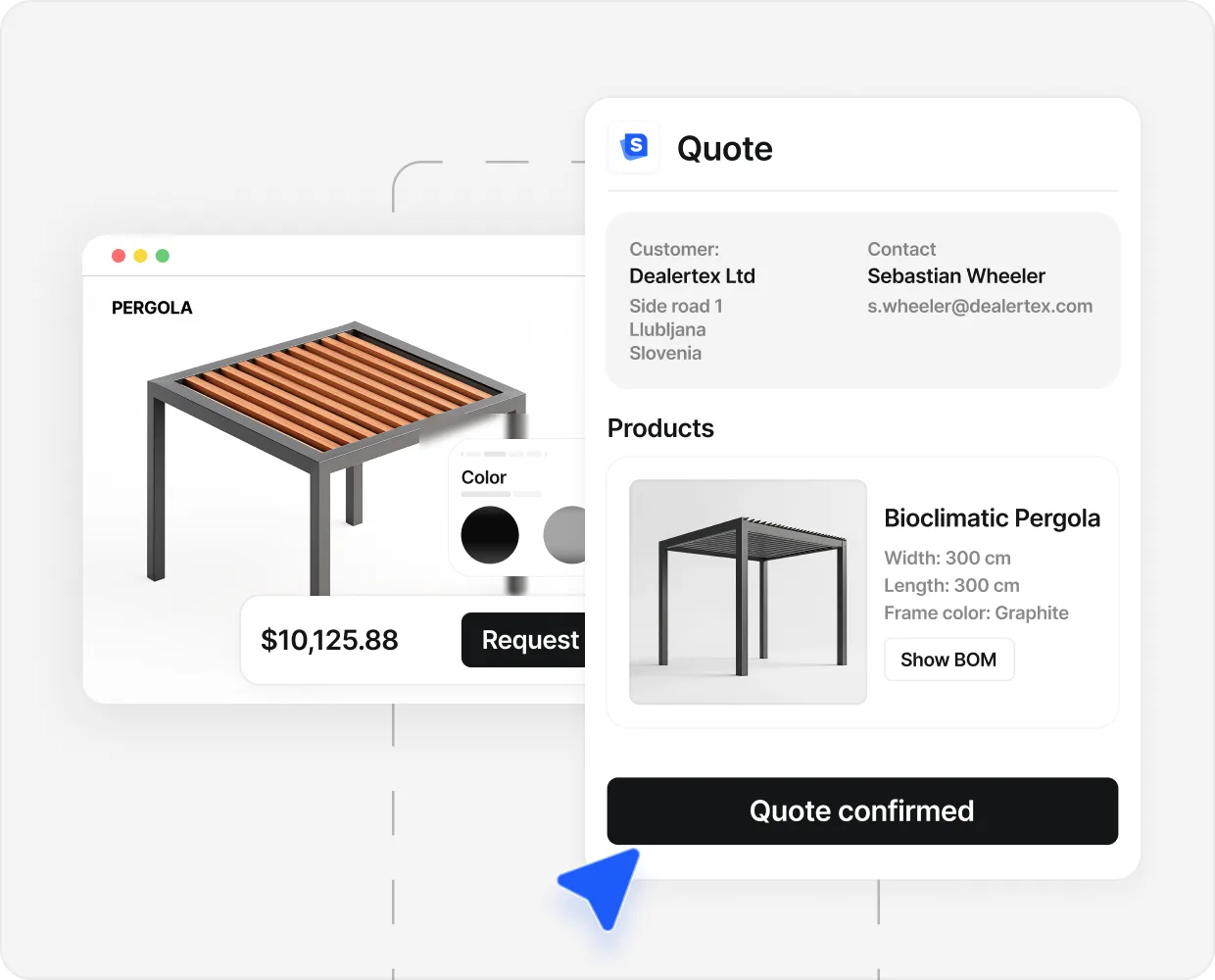
When a buyer designs a louvred pergola in a 3D configurator, the rule library fires automatically. An incompatible roof span and post system pairing is rejected the moment the buyer attempts it. The motor option for an oversized louvre is unavailable in the menu, because the rule has already filtered the list. The integrated lighting selection automatically includes the transformer line in the parts list, because the configurable bill of materials resolves to the full set of components every time. The pricing is pulled live from one source. When steel goes up on Tuesday morning, every open quote shows the new price by Tuesday afternoon, with no human in the loop.
The same configured spec writes into the CRM, into the auto-generated PDF that lands in the buyer’s inbox, and into the BOM generator that feeds production. One source of truth, three downstream artefacts, no transcription step.
The before and after numbers from real teams sit in the Hrovat case study: 10,835 hours of engineering time recovered, 415% more inquiries, €133M in quotes generated, 4x increase in lead volume, with the same team. Caribbean Blinds moved from days-long quote turnarounds to instant ones, with 40 percent of inquiries arriving as configured 3D quotes inside the first quarter. Spolding and Sons, a UK garden-room maker, generated £168K in new sales across 12 weeks with 475 qualified leads from a brand new flow. YourPergola shipped 331 quotes over four months while reclaiming 166 hours for the engineering team. The shape of the result is consistent across the case studies. Volume up, errors down, hours back.
The conversation with the buyer changes too. Before, the salesperson opens a call with “what size were you thinking” and ends it three days later with a hand-built quote. After, the buyer has already designed the product, seen the price, and self-qualified by the time the call happens. The call becomes about closing, not about gathering specs. The qualification work happens inside the configurator, which is exactly the case the guided selling layer is built to handle.
Where staying manual still wins#
The argument so far is that the structural failure of manual quoting is intrinsic to the work, and the fix is to move the rule library into software. Three cases break that pattern, in honesty.
Genuinely bespoke architectural work. If every order is a one-off, with no reusable components, the configurator has no rule library to fire. A custom-designed garden room for a one-off site, with handmade joinery and a site-specific cladding, is closer to a carpentry project than a product. The right tool there is a senior engineer in the loop, working in CAD, producing a hand-priced quote. Forcing that work into a configurator just builds a rule library nobody will reuse.
Pre-launch products under active iteration. If the product line is changing every week because the team is still figuring out which configurations will sell, the rule library moves faster than the configurator can be updated. Build the configurator after the product stabilises. Until then, the spreadsheet is the right tool, because the spreadsheet rewrites in five minutes and the configurator rewrites in five days.
Low order value, low volume. A €1,500 awning sale that goes out once a month does not justify the build cost of a configurator. The math runs the other way: the manual cost stays low because the volume is low, and the configurator amortisation runs longer than the product line will live. The threshold sits somewhere around €5,000 average order value in our experience, similar to where made-to-order manufacturing shifts from craft to system.
For everything else, which is most of customised outdoor living and most of modular construction, the manual approach is doing damage that is not visible until the quarterly review surfaces it. The damage compounds, because every error is also a referral that does not happen and a lead that walks. The five percent margin leak in pricing is the smallest part of the cost.
What this looks like in a typical Monday morning#
To make the abstraction concrete, here is what the Monday inbox of a manufacturer looks like before and after the rule library moves into software.
Before, the salesperson opens the inbox to twenty-two weekend contact-form submissions. Each one says some version of “interested in a pergola, please send pricing.” The salesperson calls eight buyers, gets through to three, asks each one for size and finish and budget, types the notes into the CRM, emails the engineering team. The engineer recalculates from the spreadsheet, double-checks two compatibility rules from memory, writes the line items, multiplies by the regional margin, emails back the price. The salesperson formats the PDF, sends it Thursday afternoon. By Friday, two of the original twenty-two buyers have signed elsewhere, four have stopped replying, and the remaining sixteen are waiting on a queue that runs three weeks deep.
After, the same twenty-two buyers arrive at the website and enter the configurator. Fourteen complete a configuration on the spot, see the price band, and either book a configured follow-up call or self-filter out because the price did not fit. The Monday inbox is now eight configured leads, each with a 3D render attached, a parts list resolved, and a price the buyer has already seen. The conversation begins at “walk me through how you designed the 4 by 5 in anthracite” instead of “what size were you thinking.” The salesperson closes the same number of deals on Wednesday that used to land on Friday. The fourteen weekend visitors who would have ghosted have either qualified themselves in or filtered themselves out, and the engineer has spent zero minutes producing the eight quotes that now sit in the pipeline.
The visual sales system we ship at SaleSqueze is built around this collapse of the translation step. The configurator is the buyer-facing surface, but the actual lever is the rule library moving from human memory into the pricing engine underneath. That is the structural change. The 3D viewer is the symptom, not the cause.
The line to take home#
Manual quoting errors are usually framed as a quality control problem, which is a polite way of saying it is the engineer’s fault. It almost never is. The fault is in the design of the work. A made-to-order product line carries more rules than a person can hold in working memory, and the errors that follow are predictable, measurable, and recoverable only by moving the library out of the head and into the system.
The conversation to have with the team is not about training, or peer review, or sign-off processes. Those are useful, and they reduce the rate by a third, and they leave the floor where it always was. The conversation is whether the rule library belongs in someone’s head or in software. If the answer is software, the build runs in one to ten days for a known category, in a quarter for a custom catalogue, and the error rate drops to under one percent in both cases. If you are weighing what to evaluate next, the SaleSqueze case-study page is the shortest path from “this might work” to “this already works for a team like mine.”
The buyer on Friday afternoon is on a competitor’s website by now. The structural fix is not to call them back faster. It is to be the company they reach first.
People also ask.
What is a manual quoting error?
A manual quoting error is any inaccuracy that enters a sales quote because a person produced it from memory or a spreadsheet instead of a rule-based system. The most common shapes are an incompatible component pair, an outdated price, a missing line item that the installer discovers on site, and a miscalculated dimension that breaks the build. They are usually called human errors. They are almost always structural errors that have been outsourced to a human.
Why does manual quoting produce so many errors?
Because the rule library lives in someone's head. A made-to-order pergola line can hold 2,000 valid configurations, each with its own compatibility rules, pricing logic, and parts list. A senior engineer can hold a few hundred of those rules at a time. The rest are reconstructed from memory on a Friday afternoon, under deadline pressure. The error rate is not a personal failing. It is the predictable result of asking a person to do a job that exceeds working-memory capacity.
What are the most common manual quoting errors in customised products?
Four show up in almost every audit. Outdated pricing applied to current orders, because the spreadsheet was not updated when steel went up in March. Incompatible components paired together, because the rule about post height versus roof span sits in one engineer's notebook. Missing line items, because the spec list was reconstructed from a phone call instead of read from a parts catalogue. Wrong dimensions, because the salesperson on site transcribed the measurement into the wrong cell. Each of the four disappears when the rule library moves into software.
How can I reduce manual quoting errors without buying new software?
Three changes help, none of them solve the problem fully. Write the pricing rules into a version-controlled spreadsheet that one named person updates weekly. Build a checklist of the eight most common compatibility traps and make every quote tick it. Quote in pairs for any order over a threshold, so two people see the parts list before it goes out. These reduce the error rate by maybe a third. They do not change the structure, so the floor of the error rate stays high. Real reduction comes from moving the rule library into a configurator.
How does a configurator reduce quoting errors?
A configurator wired to a configurable bill of materials and a pricing engine reads the rule library in real time as the buyer makes choices. An incompatible pair is rejected before the buyer sees it. A missing part cannot be selected, because the rule fires automatically. Pricing is pulled from a single source, so a Tuesday price change updates every open quote at the same time. The configurator does not need discipline. It enforces the rules by construction. The error rate drops by an order of magnitude in most categories.
What is the typical cost of a manual quoting error?
A pergola sale is €5,000 to €15,000. A garden room is £15,000 or more. A wrong configuration that the shop floor catches before installation costs the team a re-quote and a delayed delivery. A wrong configuration that the installer catches on site costs a return visit, a refit, and a damaged customer relationship that often never recovers. One UK pergola seller modelled the average all-in cost of a configuration error at the order value of the deal, because most of the recovery work consumed the margin and the next referral. The math is not subtle.
How long does it take to move from manual quoting to a configurator?
For a known category with a premade visual sales system, the timeline is 1 to 10 days. Hrovat (modular houses) and Caribbean Blinds (pergolas) both went live inside two weeks. For a custom product line with a unique rule library, the timeline stretches to a quarter or two of engineering work. The split depends on whether the vendor already knows the category. Generic configurator tools start from zero on every project, which is where the 3 to 6 month timelines come from. The total error reduction is the same in both cases. The launch curve is not.
Will moving to automated quoting cut headcount on the sales team?
No, in almost every customised-product line we have watched. The salesperson's work moves from translating specs and chasing engineers to closing buyers who arrive with a configured spec. Total deals close faster, the team takes on more inquiries, and headcount grows from there. Armat, a Slovenian carport maker, added 40 percent of revenue in three months with no new hires. The bottleneck the configurator removed was not labour. It was the translation step between the salesperson and the engineer.