

What guided selling does (and where most teams get it wrong)
A buyer reaches your homepage on a Sunday evening in early 2026. They have spent two weekends looking at pergolas, garden rooms, or carports across a dozen tabs, and they have not yet committed to one. They want to know two things before Monday morning: what would the thing they want actually look like in their garden, and what would it cost. The contact form will not answer either question. The brochure PDF answers neither. The “request a callback” button means another week of waiting.
That gap is where guided selling earns its keep. Caribbean Blinds, a UK pergola seller, watched 40 percent of inquiries arrive as configured 3D quotes the first quarter after the flow went live. Nordin, a brand-new Lithuanian pergola business, sold 30 pergolas in 90 days with no prior online presence, the configurator carrying every step of qualification. The job in both cases is the same: take the buyer from “I am interested in a louvred pergola” to “I want a 4 by 5 metre louvred pergola in anthracite, with motorised screens, at this price” in one sitting, without a salesperson having to ferry them through the decision tree. Done right, it is the difference between a Monday inbox full of cold form-fills and one full of configured, priced commitments. Done wrong, it is a quiz the buyer abandons on question four.
About 50 percent of buyers said, in effect, “I just wanted to know the price, thanks”. The configurator filtered them out before we ever picked up the phone, and that was the point.
The rest of this post is what the term actually means, what it changes about the Monday inbox, the four jobs a real system has to handle, and the most common reason teams ship one that does not work.
What guided selling is#
The original definition, the one most B2B vendors use, is broad enough to be unhelpful. Any process that helps a buyer reach a purchase decision covers everything from a brochure to a recommendation engine to a salesperson on a call. The useful definition is narrower. Guided selling is a structured buyer path that:
- takes a stated intent (the buyer wants a product in your category),
- presents the decisions that need to be made in an order the buyer can follow,
- narrows the choices in real time based on earlier answers,
- computes a price the moment the spec is fixed, and
- hands a configured output (a PDF, a CRM record, a reservation) to both the buyer and the seller.
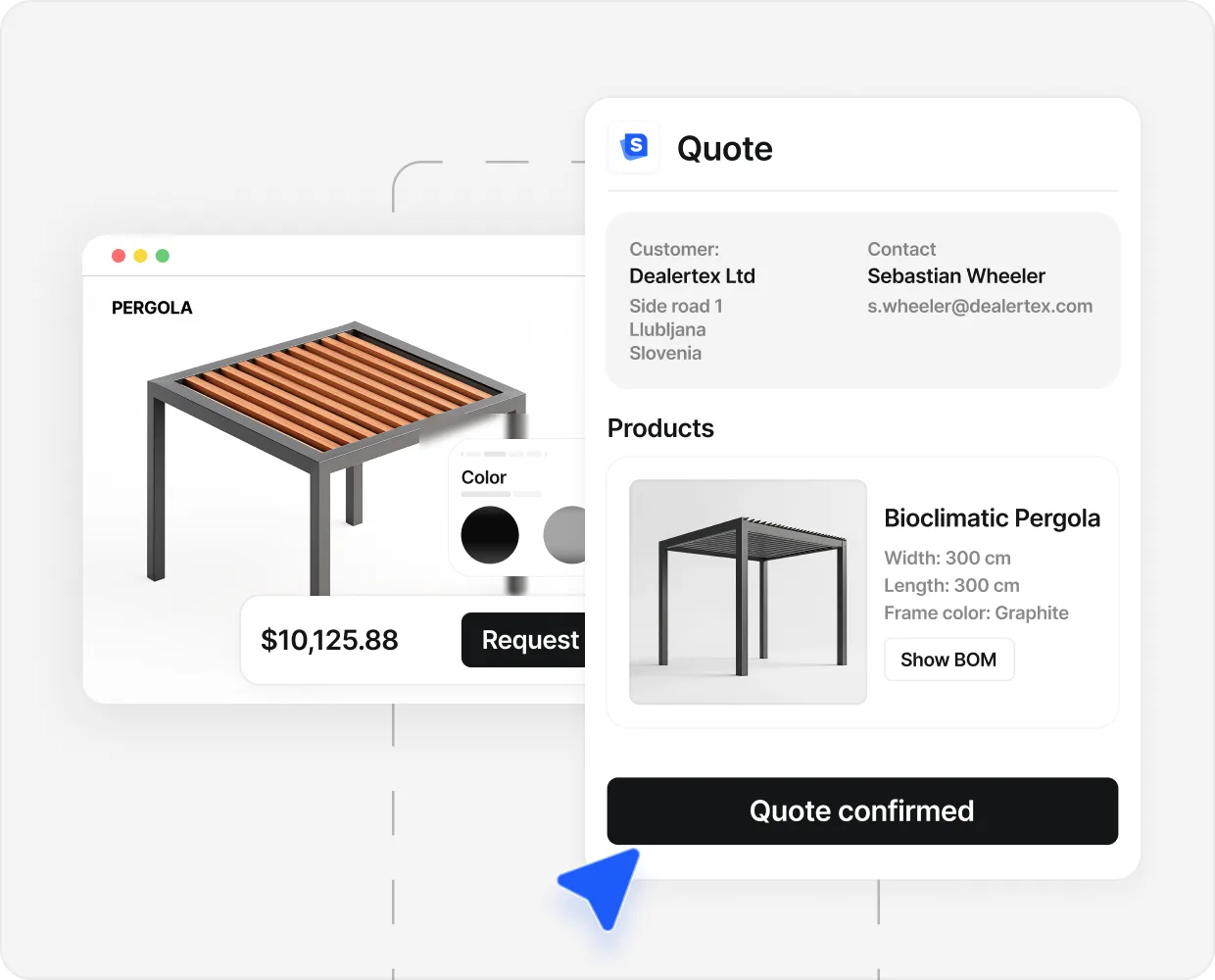
In made-to-order categories, the most common format is a 3D product configurator. The buyer designs the structure on the website, sees it from every angle, picks the materials, and receives a priced PDF before the tab closes. In simpler categories, it can be a wizard or a decision tree. The format follows the product. The function is the same.
Three terms travel close to it and are worth distinguishing. CPQ (configure, price, quote) is the back-office engine: the rules, the catalogue, the pricing logic, the quote generator. Sales configurator is a sub-class, usually a salesperson-facing tool. Guided selling is the buyer-facing layer on top of the rules engine. CPQ without a guided-selling layer is a tool the salesperson runs after a call. Guided selling without a CPQ engine is a quiz with no price at the end. Built together, they collapse what used to be a 3-day quote loop into a 90-second one.
How it changes the Monday inbox#
Before, here is how a customised-product team starts the week.
The salesperson opens the inbox to twenty-two weekend contact-form submissions. Each one is some version of “interested in a pergola, please send pricing”. The salesperson calls the first eight, gets through to three, asks each buyer for the size, the finish, and the rough budget, types the notes into the CRM, and emails the engineering team to translate the specs into priced quotes. By Wednesday afternoon, the first quote goes out. By Thursday, the third. By Friday, two of the original twenty-two buyers have signed with a competitor whose quote turned around in eight hours, and four have stopped replying. The salesperson ends the week with seven warm conversations from twenty-two starting points. The other fifteen quietly vanished into the funnel.
After, the same twenty-two buyers arrive at the homepage but enter the guided-selling flow instead of the contact form. Fourteen complete the configuration, see the price band, and either book a follow-up at a configured spec or self-filter out. The Monday inbox is now eight configured leads, each with a priced spec, a 3D render, and a PDF the buyer has already seen. The conversation starts at “you have designed a 4 by 5 metre pergola in anthracite with motorised screens, walk me through how you got there” instead of “what size were you thinking”. The salesperson closes the same number of deals in a quarter of the calling time, and the other fourteen weekend visitors who would have ghosted have either qualified themselves in or filtered themselves out.
- 508 leads in 90 days Caribbean Blinds (UK, pergolas); 40 percent of inquiries arrive as configured 3D quotes after the guided-selling flow went live.
- 30 pergola sales in 90 days Nordin (Lithuania); 574 leads from a brand new online presence, with the configurator carrying the qualification load.
- 17% close rate in low season Spa Solutions (Switzerland, pergolas); 14 deals and €214K of revenue in the winter quarter, double the prior-year rate.
- 1–10 Days to launch Premade visual sales system for a known category, with the rules and 3D models already wired.
Named numbers and the full stories live in the case studies.
The numbers above are public. The full stories sit in the Caribbean Blinds, Nordin, and Spa Solutions case studies. The pattern is consistent across all three: the volume of leads is not the headline change. The compression of the qualifying conversation is. The salesperson opens Monday at the deal-closing step, not the spec-gathering one.
The four jobs a real guided-selling system has to do#
Most teams who ship a flow that does not work miscount the jobs. They build a beautiful quiz, three weeks of design polish, and watch the conversion rate sit at 1.2 percent. The four jobs below are what separates a working guided-selling layer from a glossy abandonment funnel.
Decision sequencing. The order matters more than the question. Ask the size before the finish, the use case before the accessories, the rough budget before the cosmetic detail. A flow that opens with “what is your preferred RAL colour” is asking the buyer to commit to detail before they have committed to scope, and they drop off. A flow that opens with “what are you putting this over” gives the buyer a frame they can answer from. Read the order out loud. If it sounds like the conversation a good salesperson would have in person, it will work. If it sounds like a form, it will not.
Real-time pricing. The price has to update as the buyer changes the spec, and the price has to be honest. A flow that hides the number until a final “request your quote” step is asking the buyer to commit to a contact form before committing to anything else, which is exactly the friction the flow was supposed to remove. The buyer does not need the exact penny-precise number. They need a price band that updates as they swap the roof type or add a motor, so they can see what their choices cost them. The pricing engine underneath has to support that, which is the unglamorous half of the build.
Configured-output handoff. The moment the buyer commits, the spec has to land in three places without a person copying it. A designed PDF in the buyer’s inbox, a configured record in the CRM, and (if the BOM generator is wired) a resolved parts list ready for the shop floor. If the handoff is manual, the salesperson is back to translating a screenshot into a quote on Wednesday afternoon. The guided-selling layer has compressed the front of the funnel, but the back of it is still running on Sunday-evening labour. That is half a project, not a finished one.
The anti-fit moment. A real flow filters bad-fit buyers out as well as in. A pergola configurator that lets every buyer reach a quote, regardless of plot size, regional service area, or budget, has shifted the filtering work from the configurator back onto the salesperson. The flow needs at least one decision where the buyer is told, plainly, “this is not the right fit for you, here is why”. Counterintuitive, and it lifts conversion on the buyers who stay. The buyer who self-filters out at minute three was not closing in week four anyway. They were going to absorb six emails and a phone call before the rejection landed.
Once we said “if your plot is under 12 square metres, this isn’t the product for you”, the conversations we did have got 30 percent shorter and 40 percent more likely to close. We stopped trying to qualify out on the phone.
The technology to build the four blocks stopped being the hard part a decade ago. The hard part is the decision sequencing inside block one and the anti-fit logic inside block four. Those are the jobs that get hand-waved in the scoping doc and discovered the hard way in week three of the post-launch dashboard review.
Where most teams get it wrong#
Three failure modes that show up in roughly nine out of ten guided-selling projects that under-deliver.
The no-price quiz. The flow asks seven thoughtful questions about lifestyle, design preferences, sun exposure, and use case, and never shows a number. The buyer arrives at a final “thank you, we will be in touch” screen and an email gets sent. The drop-off curve is brutal. Fix: show a price band as early as question one. Update it live. Trust the buyer with the number. The buyer who walks because the price is too high was always going to walk; they walk in question one instead of week three.
Too many decisions, no defaults. The flow lets the buyer pick from forty configurations on every variable, with no recommended path. Buyers stall in the configuration. Fix: default the eighty percent of buyers who pick the standard spec to the standard spec, and let the other twenty percent customise. The split is not a guess. In most outdoor living categories, 80 to 90 percent of buyers pick the standard option on at least the size and the finish. Treat the standard as the default, not the starting point.
No anti-fit, so the inbox fills with tyre kickers. The flow lets every buyer finish, and the result is a Monday inbox of configured specs from buyers who were never going to buy. The salesperson now has more work to do, not less. Fix: a serious-buyer detection step inside the flow, gated on something verifiable (postcode, plot size, project timeframe), that filters out the visitors who are not in market for this product, in this region, at this stage. The work the configurator does on the way in is the work the salesperson does not have to do on the way out.
When guided selling is not worth building yet#
Three honest cases where the work does not earn its keep.
The product is genuinely bespoke. If every order is a one-off architectural piece with no reusable components, the configurator’s rule library has nothing to resolve. The right tool there is an engineer-in-the-loop quoting workflow with a salesperson coordinating, not a buyer-facing flow with a parametric model behind it.
The average order value is under 5,000 euros. Below that line, the unit economics for instrumenting a real guided-selling layer get tight, because the project cost has to amortise across closed deals. Above it, and especially in the 8,000 to 35,000 euro range that outdoor living and modular construction sit in, the flow funds itself inside the first quarter. This is roughly the same threshold that decides whether a configurable BOM is worth instrumenting at all.
The product is brand new and changing weekly. Building a decision sequence and a rule library against a product that is still in pre-launch iteration is a way to spend a quarter writing logic that gets binned in week two of the actual launch. Wait until the product line stabilises. Guided selling is a lever for a known category, not a way to design the category itself.
For the categories that survive those three filters, which is most of outdoor living and most of modular construction, the guided-selling layer is the difference between a 3-day quote loop and a 90-second one. The configurators we ship at SaleSqueze are built around guided-selling flows that already know what a louvred pergola, a garden room, a carport, or a louvred awning actually is, which is why the launch timeline is in days, not months.
The line to take home#
Guided selling is not a quiz. It is not a brochure with a form at the end. It is buyer-flow UX with a pricing engine attached, and its job is to compress the conversation between an interested visitor and a closed deal from three weeks to one sitting. The teams who get it right treat it as a filter. The teams who get it wrong treat it as a recommendation engine.
If you are weighing where to start, the first decision is not the format. It is the anti-fit moment. Write the one sentence you are willing to put in front of a buyer that says “this is not the right fit if X”. If that sentence is honest, the rest of the flow will work. If it is missing, the flow will fill your inbox with the same visitors who were ghosting on Tuesday afternoons.
People also ask.
What is guided selling?
Guided selling is a structured way of helping a buyer reach a specific, priced product spec on their own, before a salesperson opens a conversation. The buyer answers a sequence of decisions about size, finish, options, and use case, and the system narrows the choices in real time. The output is a configured product, a price, and a record the seller can act on. The point is not to replace the salesperson. It is to remove the back-and-forth that happens before a serious buyer is ready to talk.
What is the difference between guided selling and CPQ?
CPQ stands for configure, price, quote. It is the back-office machinery that holds the rules, prices, and quote-generation logic. Guided selling is the buyer-facing layer that walks the buyer through the decisions in an order they can follow. CPQ without guided selling is a salesperson tool. Guided selling without CPQ is a quiz with no price at the end. The two work together: guided selling is the buyer's path, CPQ is the engine the path runs on.
Is guided selling the same as a product configurator?
A product configurator is one of the most common shapes guided selling takes, especially for made-to-order categories like pergolas, garden rooms, or fences. The configurator presents the choices visually, often in 3D, and resolves the spec, price, and PDF in one flow. Guided selling can also be a decision tree, a quiz, or a wizard for simpler products. The shape depends on how much the buyer needs to see before they decide.
Why do teams call it guided selling instead of a configurator or a quiz?
The term focuses on the job, not the format. The job is to take a buyer from a vague intent (I want a pergola for my deck) to a specific, priced commitment (a 4 by 5 metre louvred pergola in anthracite, with motorised screens, at this price) without a salesperson having to ferry them through every decision. Configurator, quiz, decision tree, and chatbot are all formats. Guided selling is the function those formats serve.
Does guided selling work for B2B or only consumer-facing sites?
Both. In B2B, the buyer is often a procurement officer or a project manager who needs the spec and price to bring to an internal stakeholder. Guided selling shortens that internal conversation by giving them a configured PDF they can forward. In consumer-facing outdoor living, it shortens the homeowner's research phase from days to one sitting. The format changes (more technical inputs for B2B, more visual reassurance for B2C), the function does not.
How long does it take to launch a guided selling system?
For a known product category with a premade configurator template (pergolas, garden rooms, carports, fences, awnings), a guided-selling layer goes live in 1 to 10 days. For a custom product with a unique rule library, the timeline is 3 to 6 months because the rules, the 3D models, and the pricing engine have to be built from zero. The fastest implementations are the ones where the vendor already knows the category.
Will guided selling cannibalise my salespeople?
Only if the rest of the operation is set up to need cannibalising. Most teams that ship a guided-selling layer find the opposite. Buyers who would have ghosted in the contact-form stage now arrive at the first sales call with a configured spec, which compresses the conversation from an hour to fifteen minutes and lifts the close rate. The salesperson's time moves from spec translation to closing. Headcount usually grows from there, not shrinks.
What happens if I get the guided selling flow wrong?
The most common failure mode is treating guided selling as an education exercise. The buyer is asked seven questions about their lifestyle, design preferences, and use case, but never sees a price. They drop off in the same place every time, around question four. The fix is the inverse of intuition: show the price band early, gate the technical detail later, and let the buyer self-filter on the bit that matters first. Information density beats decision density at the top of the flow.