CPQ software for manufacturing (and why most teams Googling it are in the wrong category)

Most owners I speak with in made-to-order manufacturing have been Googling the same three words for six months and losing patience with the results. The words are CPQ for manufacturing. They picked them up from an analyst report or a LinkedIn post, opened a demo from one of the big CPQ vendors, and sat through 40 minutes on approval workflows, discount tables, and quote-revision history. Nobody on the call said “pergola” or “modular cabin” or “homeowner”. They thanked the rep and went back to building quotes by hand on a Sunday evening, more confused than when they started.
That confusion is the right signal. The category they searched and the category they need are not the same one. The vocabulary was set by enterprise software vendors with the marketing budget to define the words, and the words drifted away from the work most made-to-order manufacturers do day to day.
The vendor landscape, in four groups#
Search “CPQ for manufacturing” and you get roughly thirty names. They are not thirty options. They are four groups, and most manufacturers only ever belong in one.
The suite CPQs. Salesforce CPQ (formerly Steelbrick), Oracle CPQ (formerly BigMachines), SAP CPQ. Each lives inside its parent suite and assumes you already run it. Implementations regularly clear six figures and run 6 to 18 months, including weeks of rep training. Right answer if you already live in that suite and sell through 50-plus reps.
The independent enterprise CPQs. Conga, PROS, Zilliant, IBM Sterling. Same enterprise motion, no suite lock-in. Strong on discount governance, approval chains and negotiated terms. Still a rep tool behind a login.
The manufacturing specialists. Tacton, Experlogix, Configure One, Epicor CPQ. The closest fit for engineer-to-order work, with real constraint solvers and CAD or ERP integration. If you genuinely sell engineer-to-order machinery, look here first. Setup runs 20,000 to 50,000 euros plus monthly, and they expect an internal project owner.
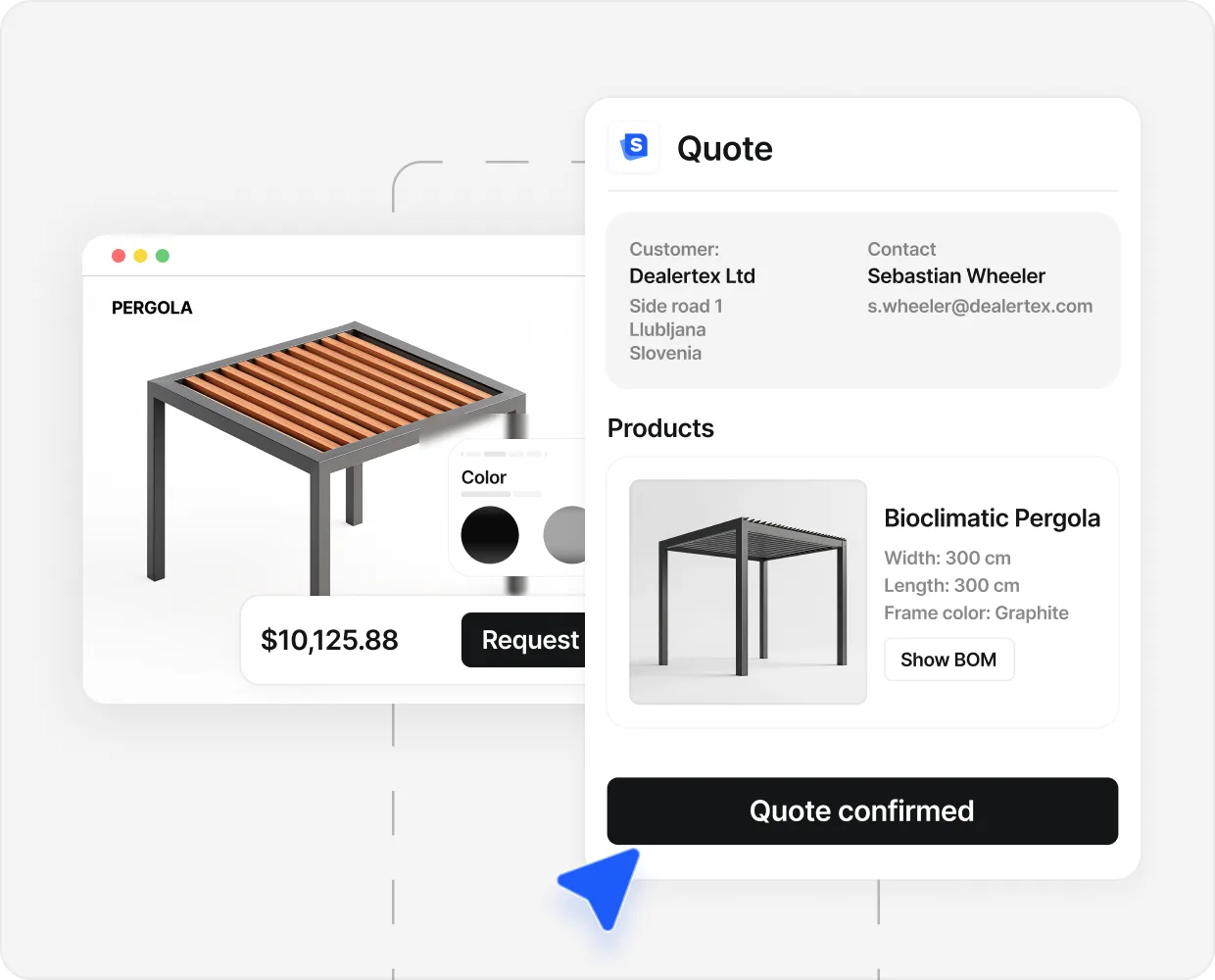
The customer-facing configurators. A newer group aimed at the public website rather than the rep’s desk. The buyer configures, prices and requests the quote themselves. Setup is days rather than months when the vendor already has a template for your category.
The trap is pattern-matching on the famous word. The first three groups sell to a sales organisation. Most made-to-order manufacturers do not have one. They have a website, a small team, and a quote backlog.
We moved the configuration work from our small in-house team to a public website. Eleven thousand leads, eight thousand hours saved, 133 million euros in quotes through the configurator. The shift was not the software. The shift was the door.
How to read a shortlist#
Four questions cut thirty names to two or three fast.
Who sits in front of the screen? If the answer is your rep, you are shopping in groups one to three. If it is your buyer, only group four applies. This single question eliminates most of the list.
Does the vendor already know your product? A vendor with a template for pergolas, cabins or fences ships in days. A vendor without one learns your category on your budget, over months.
What does it cost to change a rule? Prices and constraints change every season. If a margin edit means a support ticket and a two-week queue, the tool will drift out of date within a year.
Where do the events go? Enterprise CPQ reports into sales. A public configurator has to fire into Meta, Google Ads, GA4 and the CRM, or you cannot tell which ads produced which configured quote.
The full line-by-line comparison of the two models is in sales configurator vs CPQ.
Who needs which category#
Traditional CPQ fits if you sell industrial equipment, enterprise software, or B2B services through a sales team of 50 or more, the deals run six figures or more, the procurement cycle runs months, the approval chain involves multiple stakeholders, and the buyer expects to negotiate. The configuration work is mostly translating stated requirements into the right SKU bundle, and the rep does the translating.
A customer-facing configurator fits if you sell a physical, customisable product to homeowners, contractors, architects, or trade buyers, through a website with meaningful traffic. Deals run 5,000 to 100,000 euros. The buyer wants to see the product before they ask the price. The sales team is small enough that every inquiry matters, and the bottleneck is quote turnaround, not approval workflows. This is most of outdoor living, modular construction, custom kitchens, made-to-order furniture, fencing, garden buildings, and a long tail of mid-market manufacturing.
Both fit if you sell into both consumer and enterprise channels (a modular construction company selling garden cabins direct and bidding on multi-family tenders). Rare, and almost never the right place to start. Pick the channel that drives more revenue this year, instrument it, revisit the second when the first is paying for itself.
The trap is to pattern-match on the famous word. Customer-facing configurators were not a budgeted category until five years ago. The right tool for a mid-market outdoor living dealer or a modular-cabin manufacturer is not the famous one.
What the numbers look like on the manufacturing side#
The category argument matters less than what happens to the shop floor. Three effects show up consistently.
The quote backlog clears. The standard loop runs one to three days per quote, and much of it lands on somebody’s weekend. When the buyer configures, the loop is the configuration session itself.
Engineering hours come back. The hours saved are mostly spec-translation hours: an engineer turning a sales note into a parts list. A configurable BOM resolves that at the moment the buyer picks.
Cost per qualified lead falls sharply. Same ad spend, better mix, because the configurator filters before the rep sees anything.
- €133M in quotes generated Mizarstvo Hrovat (Slovenia, garden rooms and modular houses); 415% more inquiries, 10,835 hours saved.
- 50 to 700 inquiries per year Impol (Slovenia, fences); 14x lead flow after the configurator went live on the public website.
- +40% revenue in 3 months Armat (Slovenia, carports); 1,873 leads through the configurator, no new salespeople hired.
- 10 to 20x drop in cost per qualified lead Across the customer base, first 90 days after a configurator goes live on the website.
Named numbers, full stories in the case studies.
The 133 million in quotes from Mizarstvo Hrovat is worth sitting with. A Slovenian garden-room and modular-house manufacturer moved the configuration work from a small in-house team to a public website over 30 months. Eleven thousand leads. Eight thousand hours saved, most of them Sunday-evening hours nobody was getting back.
Underneath every story is the same chain. The buyer configures, the configurable BOM resolves the parts list, the pricing engine computes the number, the PDF reaches the buyer, the CRM record reaches the rep, and the ERP receives a production-ready spec.
The line to take home#
CPQ is real and useful in the enterprise motion it was built for. Most teams Googling “CPQ for manufacturing” are not in that motion.
Work through the four groups and be honest about which one you belong in. If you sell a physical, customisable product through a public website, the first three are the wrong shelf, however many analyst reports name them.
Live examples across pergolas, garden rooms, carports and fences sit in the gallery. For how the configurator hands off to the production floor, see the platform page.
People also ask.
How many CPQ vendors are there really?
Search returns about thirty names, but they sort into four groups: suite CPQs (Salesforce, Oracle, SAP), independent enterprise CPQs (Conga, PROS, Zilliant, IBM Sterling), manufacturing specialists (Tacton, Experlogix, Configure One, Epicor), and customer-facing configurators. Most manufacturers belong in exactly one.
Do I need CPQ if I sell pergolas, garden rooms, fences or modular buildings?
Almost certainly not. CPQ was built for enterprise teams quoting complex B2B contracts. If you sell a made-to-order product through a public website, you need the customer-facing version, where the buyer designs and prices it themselves.
Which manufacturers should still buy traditional CPQ?
If you sell industrial equipment into large procurement teams on six-figure contracts with negotiated discounts and multi-tier approvals, CPQ is right. Nobody configures a turbine on a website.
How much does each cost?
Enterprise CPQ commonly runs six figures in licensing and integration over 6 to 18 months. Manufacturing specialists run 20,000 to 50,000 euros plus monthly. A premade configurator for a known category is a subscription, live in 1 to 10 days.
Can a configurator integrate with the same CRM and ERP?
Yes, and that is usually the point. It fires events into the CRM on design, price and submit, and can push the configured BOM into the ERP for production planning.