

Sales configurator vs CPQ (the same job, 2 different doors)
Most outdoor living owners I talk to have been Googling the same word for six months and slowly losing patience with the results. The word is CPQ. They picked it up from a Salesforce article, or an industry analyst report, or a sales coach who used to sell software, and it sounded like the right name for the thing they need. Then they opened a demo from one of the big CPQ vendors and watched a 40-minute walkthrough of approval workflows, discount tables, and quote-revision history. None of it spoke their language. Nobody on the call said “pergola” or “louvred roof” or “homeowner”. They thanked the rep and went back to building quotes by hand on a Sunday evening, more confused than when they started.
The problem is not the buyer. The problem is that the search query and the product they actually need have drifted apart, and nobody told them. CPQ is a real category. It also is not the category they want.
We grew revenue by 40 percent in three months without hiring a single new salesperson. The configurator on the website did the work my team used to do by hand.
A sales configurator and a CPQ tool do the same underlying work, which is why the words get tangled. They both apply configuration rules. They both compute a price. They both produce a quote. The difference is who is sitting in front of the screen, and that difference changes almost everything about what the software has to look like, how fast it has to load, what it has to talk to, and what success even looks like at the other end.
What CPQ historically meant#
CPQ stands for configure, price, quote. The category was defined in the late 1990s and early 2000s, when enterprise sales teams ran into a translation problem. Their products had grown too complicated for a salesperson to price by hand, the catalogue had become too long, the discount tables had too many cross-rules, and the quote-approval chain ran through three managers and a legal review. CPQ software was built to live inside that mess. It sat alongside Salesforce, SAP, or Oracle, and it gave the rep one tool that walked them through the configuration of a complex offer, applied the right pricing rules, generated the quote PDF, and triggered the approval workflow.
The audience was always internal. CPQ is a sales rep’s tool. The buyer never logs into it. The buyer receives the output, which is usually a PDF or a contract sent over email, and the rest of the buying conversation happens in person, on a call, or in a procurement portal. The category leaders of the last fifteen years all built their products around that assumption: Salesforce CPQ (formerly Steelbrick), Oracle CPQ Cloud (formerly BigMachines), SAP CPQ (formerly CallidusCloud). The pricing reflects the audience. Implementations regularly run six figures, project timelines run six to eighteen months, and the rollout includes weeks of sales-team training.
That works when you have a 50-rep team selling 200,000-dollar enterprise contracts with quarterly renewal cycles. It does not work for a pergola dealer in Manchester or a fence manufacturer in Poland. The total addressable rep training budget is one person. The product the buyer is buying is not a renewable contract. It is a specific 4 by 5 metre pergola with louvred roof slats, anthracite finish, and motorised side screens, costing 14,500 euros, installed in eight weeks.
The CPQ category, in other words, is real and useful in the world it was built for. It just was not built for the world most outdoor living teams sell in.
What a sales configurator does instead#
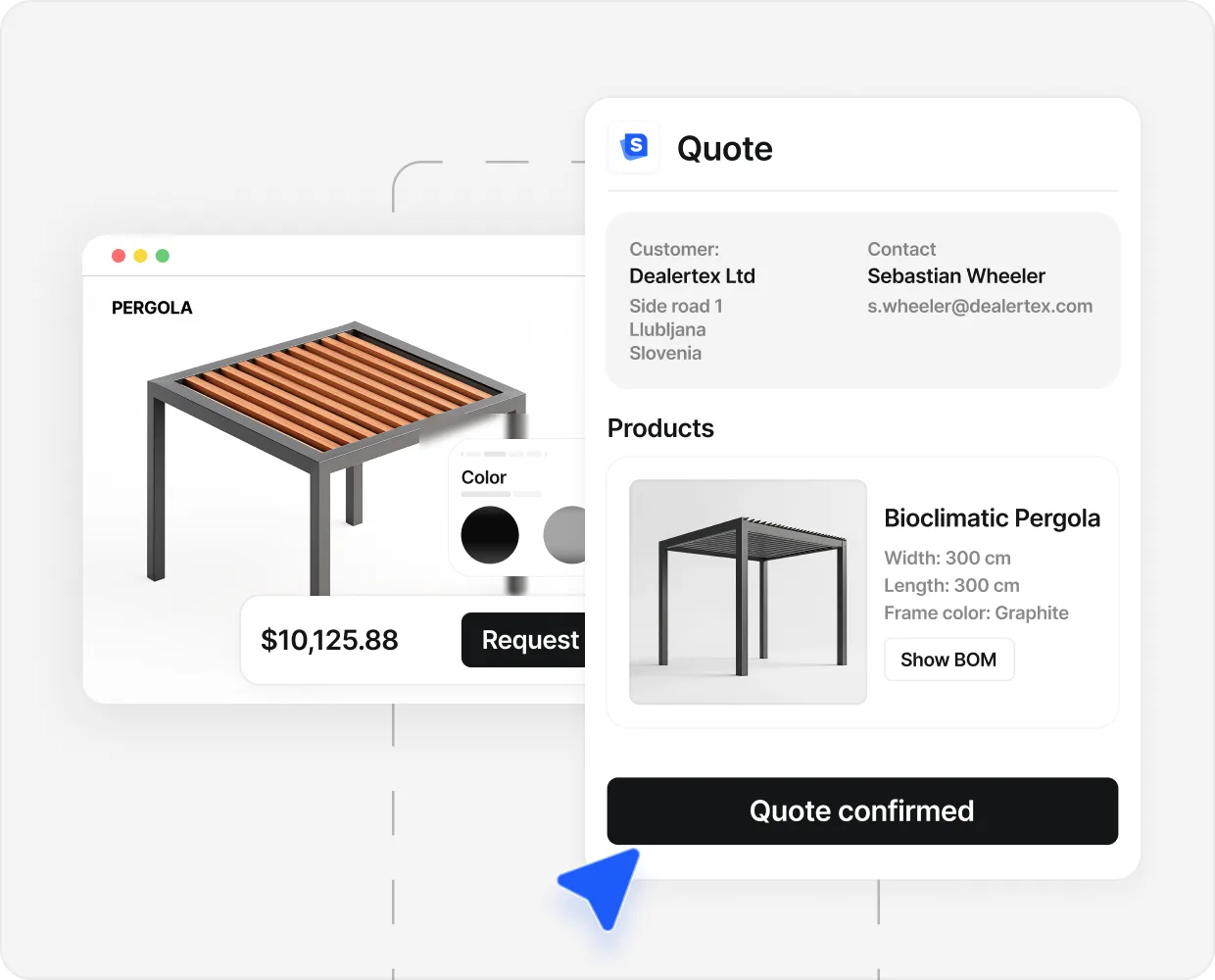
A sales configurator sits on the public website. There is no login, no training session, no approval workflow. The buyer arrives at the page, sees a 3D model of the product, picks the options, watches the price compute in real time, and receives a designed PDF before they close the tab. The same tool that priced the build also writes a CRM record, fires events into the manufacturer’s ad platforms, and routes the inquiry to the right dealer if the manufacturer runs a network.
That is the surface. What sits underneath is, structurally, the same job CPQ does. A configuration rule library decides which combinations are valid. A pricing engine computes the cost of goods, the regional modifiers, the installation cost, and the margin. A quote-generation step renders the PDF and pushes the record into the CRM. The difference is where the work happens. In CPQ, the work happens behind a login, after the buyer has already engaged with a salesperson, and the salesperson drives the configuration. In a sales configurator, the work happens on the public web, before the salesperson has been involved, and the buyer drives the configuration themselves.
The shift in who drives changes every constraint on the software:
Speed has to be sub-second. A sales rep will wait three seconds for a CPQ form to load because they are paid to. A homeowner on a phone will not. If the 3D model takes eight seconds to render on a 4G connection, the buyer is back in their Instagram feed before the pergola resolves. The mobile performance budget is unforgiving, and most generic configurator vendors fail it.
The interface has to read as a website. A CPQ form can look like a B2B form because the rep was trained to use it. A sales configurator has to feel like the rest of the brand, has to handle a buyer who has never seen a product configurator before, and has to communicate the next step at every stage without a manual. The interface design budget is the largest single line item in most real configurator projects.
The events have to land in marketing tools, not just sales tools. When a buyer designs a pergola, the configurator should fire events into Meta, Google Ads, GA4, and the CRM, because half the reason the funnel converts at all is that the manufacturer can now retarget the buyer who configured but did not submit. CPQ tools do not do this because they were never on the marketing surface to begin with.
The PDF is the product. A CPQ quote is a contract document the rep walks the buyer through. A sales configurator’s PDF is the first thing the buyer sees with the manufacturer’s logo on it, often on a Saturday at 11pm, with no salesperson involved. It has to read like a brochure and a quote at the same time. It has to be the thing the buyer forwards to a partner without explanation.
The job is the same. The execution is so different that the two tools are not really substitutes. A CPQ tool dropped onto a homeowner-facing website will collapse the conversion rate. A sales configurator dropped into a 50-rep enterprise sales motion will not handle the approval logic. Picking the wrong door costs the same amount as picking neither.
Who needs which one#
The honest answer depends on three questions. Who is the buyer. How complicated is the deal. How many reps are involved.
You probably want CPQ if: you sell enterprise software, industrial equipment, or B2B services through a sales team of 50 or more. The deals run six figures, the procurement cycle runs months, the approval chain involves multiple internal stakeholders, and the buyer expects to negotiate price and terms. The configuration is mostly about translating the buyer’s stated requirements into the right SKU bundle, and the salesperson is the one who does the translating. The buyer never needs to see a 3D model because there is nothing to render.
You probably want a sales configurator if: you sell a physical, customisable product to homeowners, contractors, architects, or trade buyers, through a website that gets meaningful traffic. The deals run between 5,000 and 100,000 euros. The buyer wants to see what the product will look like before they ask the price. The sales team is small enough that every inquiry matters, and the bottleneck in the operation is not approval workflows but quote turnaround. This is most of outdoor living, modular construction, custom kitchens, made-to-order furniture, and a long tail of mid-market manufacturing.
You probably want both if: you sell complex configured products into both consumer and enterprise channels. A modular construction company that sells garden rooms direct to homeowners and also bids on government tenders may want a sales configurator on the homeowner site and CPQ for the tender team. The two tools coexist because they serve different buyers in different motions. This is rare, and almost never the right place to start. Most teams that try to do both at once fail at both. Pick the channel that drives more revenue this year, instrument it, and revisit the second one when the first one is paying for itself.
The trap is to pattern-match on the word and pick the famous category. CPQ is famous because the vendors had decades of enterprise budget to spend on marketing. Sales configurators were not a budgeted category until five years ago. The vocabulary is lopsided. The right tool for an outdoor living dealer is not the famous one.
Sales configurator vs CPQ at a glance
Sales configurator
Lives on your website. The homeowner, contractor, or architect configures, prices, and submits before any salesperson is involved. The PDF lands in the inbox and the CRM at the same time.
- Sub-second load on mobile
- 3D model + photoreal renders
- Events into Meta, Google, GA4, CRM
- Per-seller monthly subscription, live in 1–10 days
CPQ
A salesperson's internal tool. Translates a stated requirement into a priced quote inside an enterprise sales motion. Buyer never logs in. Built for 50-plus rep teams selling complex contracts.
- Approval workflows + discount tables
- Built for desktop + training
- Enterprise CRM integration only
- Six-figure implementation, 6–18 month rollout
By Monday morning, 40 percent of our inquiries already came in as configured 3D quotes. We didn’t add anyone to the sales team. We just stopped asking the team to do the configuration work the buyer was happy to do themselves.
Why outdoor living got told to use CPQ#
The history is worth telling because it explains the search-query confusion. In 2010, the only software category for “customisable product pricing” was CPQ. Salesforce had not yet acquired Steelbrick, BigMachines was still BigMachines, and the entire vocabulary of customised-product selling lived inside enterprise software vendors. The phrase “sales configurator” existed, but in the industry it usually meant a CPQ module rebranded for a specific vertical, and was still sold to enterprise sales teams.
Outdoor living manufacturers, modular construction companies, and other made-to-order categories had two options. Build something custom, which meant six-figure freelancer projects and 18-month timelines. Or borrow the language of the only existing category and ask a CPQ vendor for help. Both failed. Custom builds did not survive the third revision cycle. CPQ vendors quoted the implementation against an enterprise scope and lost the deal at the second meeting.
The shift started around 2018, when WebGL got mature enough to render product configurators in a browser without a plugin, and a generation of category-specific vendors built tools for the actual job. By 2024 the category had a name (sales configurator, product configurator, visual configurator, depending on who you read), a working unit economics model (per-seller monthly subscription instead of seven-figure license), and live deployments in the thousands. The search-query gap is the lag. Buyers are still typing the word they learned in 2015, and Google still rewards the CPQ vendors who outranked the new category for ten years before the new category existed.
That is changing. Search interest in “sales configurator”, “quote configurator”, “product configurator”, and “3D configurator” has grown faster than the CPQ category for three years running. The vendors who actually build these tools now show up in the results, the case studies have started to accumulate, and outdoor living teams are gradually correcting the word. The lag is closing. The teams who close it earliest get the funnel advantage.
What changes when the buyer configures#
The reason any of this matters is that moving the configuration work from the rep to the buyer changes the math of the funnel in ways no enterprise software vendor accounted for.
Quote turnaround collapses. The standard custom-product loop is one to three days from inquiry to quote. The salesperson reads the contact form, calls the buyer, asks for the spec, drives out to measure if needed, hands the spec to an engineer who builds the parts list, prices it, and sends the PDF. That loop is dead labour from the buyer’s perspective. Half of it happens on the salesperson’s weekend. When the buyer configures on the website, the loop is the configuration session itself. Twelve minutes, on a Saturday at 11pm, with a priced PDF in the buyer’s inbox before the salesperson has had a coffee on Monday morning.
Lead quality jumps. The contact form is replaced by the configuration session. A buyer who spends twelve minutes in a configurator, swaps the roof type four times, changes the size from 4 by 4 to 4 by 5, picks the anthracite finish, and submits, is qualified in a way no contact-form lead ever is. The salesperson opens Monday’s inbox to twelve qualified inquiries with configured PDFs and twelve scratch contact-form leads, and learns within a quarter that the configured ones close at three to five times the rate of the form leads.
Cost per qualified lead drops by an order of magnitude. This is the consequence of the previous two combined. The same ad spend, against the same campaign, produces the same gross leads. But the proportion of those leads that turn into a quote, then into a closed deal, jumps because the configurator filters the tire-kickers and prepares the serious buyers. In our customer data the cost per qualified lead drops by 10 to 20 times in the first quarter after rollout. Not because the ads got cheaper. Because the funnel finally extracts work from the buyer that the salesperson used to do unpaid.
- +40% revenue in 3 months Armat (Slovenia, carports); no new hires, 1,873 leads through the configurator.
- €133M in quotes generated Mizarstvo Hrovat (Slovenia, garden rooms); 415% more inquiries and 10,835 hours saved over 30 months.
- 508 leads in 90 days Caribbean Blinds (UK, pergolas); 40 percent of inquiries arrive as configured 3D quotes.
- 10–20× drop in cost per qualified lead Across our customer base in the first 90 days after a configurator goes live on the website.
Named numbers and the full stories live in the case studies.
The biggest of those numbers, the 133 million in quotes from Mizarstvo Hrovat, is the one most worth sitting with. Hrovat is a Slovenian garden-room and modular-house manufacturer. They moved the configuration work from a small in-house team to a public website over a 30-month window. Eleven thousand leads. Eight thousand hours saved. Most of those hours were Sunday-evening hours that nobody was getting back. The configuration work the buyer did on the website was identical, structurally, to the configuration work a CPQ tool would have asked a rep to do. The shift was not the software. The shift was the door.
The Armat number tells the same story at a smaller scale. Andrej and his team sell carports in Slovenia. Forty percent revenue growth in three months, no new hires. The configurator on the website does the spec work the team used to do by hand on a notepad. The conversion stays the same. The volume goes up because the funnel stops leaking on quote turnaround. The team stays the same size because the new revenue did not come from new salespeople. It came from the salespeople they already had, walking into Monday with configured PDFs instead of contact-form lines.
The category cousin underneath both stories is the configurable BOM the configurator quietly relies on. The buyer configures on the surface. The cBOM resolves the parts list. The pricing engine computes the price. The PDF lands in the buyer’s inbox. The CRM record lands on the rep’s desk. Nothing about that chain is unique to a sales configurator versus a CPQ tool. The chain is the same. The buyer-facing surface is what changes the economics of the whole system.
The line to take home#
CPQ is internal sales software. A sales configurator is the customer-facing version of the same job. If you sell software to 50-rep enterprise teams, CPQ is the tool. If you sell pergolas, carports, garden rooms, fences, or any other customised physical product to homeowners and contractors, a sales configurator is the tool. The same engine sits under both, but the door changes who walks through it, and the math of the funnel changes with the door.
The CPQ vocabulary will lose more ground every quarter. The sales configurator vocabulary will keep gaining it. The team that switches first stops competing for buyers who already know what they want and starts catching buyers earlier in the search than the competition that is still doing manual quoting on a Sunday evening.
If you want a longer look at the surface the buyer actually sees, the 3D product configurator overview covers the visual side of the work, and the configurators hub carries the live working examples across pergolas, garden rooms, carports, awnings, and fences. The Armat case study is the simplest read of the +40 percent revenue story, and the Hrovat case study is the longest read of the same shift across a larger operation.
People also ask.
What is the difference between a sales configurator and CPQ?
CPQ, short for configure, price, quote, is internal sales-rep software. It sits behind a login and a salesperson uses it to translate a customer's spec into a priced quote. A sales configurator does the same job on the public website, with the buyer doing the configuring directly. CPQ is the rep's tool. A sales configurator is the buyer's tool. The work the software does is similar. The person sitting in front of it is not.
Is a sales configurator just CPQ for customers?
Roughly, yes. The shape of the work overlaps. Both apply rules, both compute a price, both produce a quote. The differences are operational. A sales configurator has to be fast on a phone, has to render the product in 3D for buyers who have never seen one before, has to fire events into your ad platforms and CRM, and has to read like a website not a B2B form. A CPQ tool can assume a logged-in user, a training session, and a desktop. Different audiences, different surfaces, similar engine underneath.
Do I need CPQ if I already have a sales configurator?
Most outdoor living manufacturers and dealers do not. The customer-facing configurator already handles configuration, pricing, and quote generation for 95 percent of orders. CPQ adds value when you have a 50-plus rep sales team selling complex enterprise deals with custom terms, volume discounts, and approval workflows. For a pergola dealer, a garden room manufacturer, or a fence installer, that machinery is overhead. The configurator on the website does the job the CPQ vendors are pitching.
Why does the CPQ category get all the search volume?
Historical accident. CPQ vendors like Salesforce, Oracle, and SAP have spent two decades selling into enterprise procurement teams, and the vocabulary set by their marketing now dominates the search results. Outdoor living got told the same word applied to their world because that was the only word available. It does not. A homeowner buying a pergola will never see a CPQ tool. They will see a configurator on the manufacturer's website, and that is what closes the deal.
What does a sales configurator cost compared to CPQ?
Enterprise CPQ implementations commonly run 100,000 dollars or more in licensing and integration, with 6 to 18 month rollout timelines. A premade sales configurator for a known product category runs a per-seller monthly subscription and goes live in 1 to 10 days. The order-of-magnitude gap is not because one is cheaper software. It is because CPQ is sold to enterprises and a sales configurator is sold to manufacturers and dealers. Different buyers, different price points, different deployment timelines.
Will a sales configurator replace my sales team?
No, and any vendor who pitches it that way is selling something else. The configurator does the spec work and the first-pass pricing. The close still happens between a buyer and a real person, especially above 15,000 euros. What changes is what the salesperson walks into. A configured PDF and a qualified inquiry, instead of a contact form and a guess. Most teams that ship a sales configurator end up hiring more salespeople over the next two years, not fewer, because the funnel finally produces enough qualified inquiries to justify the headcount.
Can a sales configurator integrate with my existing CRM?
Yes, and that integration is usually the whole point. A serious sales configurator fires events into the CRM the moment a buyer designs, prices, and submits, and writes the configured spec and the priced PDF as fields the salesperson can act on. The integration is what makes the configurator a sales tool instead of a 3D viewer. Without it, the sales team logs into the configurator vendor's dashboard to find new leads, which nobody does for long. The handoff has to be automatic.
Is a sales configurator the same as a product configurator?
Often, yes. The terms get used interchangeably, and most outdoor living teams will not notice the difference. The slight distinction in industry usage is that a product configurator emphasises the 3D model and the visual configuration experience, while a sales configurator emphasises the downstream sales artefacts, the priced PDF, the CRM record, the ad events, the CRM handoff. In practice the same tool covers both jobs. If a vendor sells you a product configurator without the sales artefacts wired in, you have bought half a tool.