
What a digital showroom is (and the 8 jobs it has to do)
A buyer walks into a physical pergola showroom on a Saturday morning. There is one louvered pergola on the floor, two posts deep, in anthracite. The salesperson asks what size garden they have, fetches a brochure, scribbles on it, leaves the room to call the workshop, comes back with a number, walks the buyer to the door, and hands over a card. By Monday morning, the buyer has forgotten the number and remembered three other pergola companies. The deal goes to whichever one rings first.
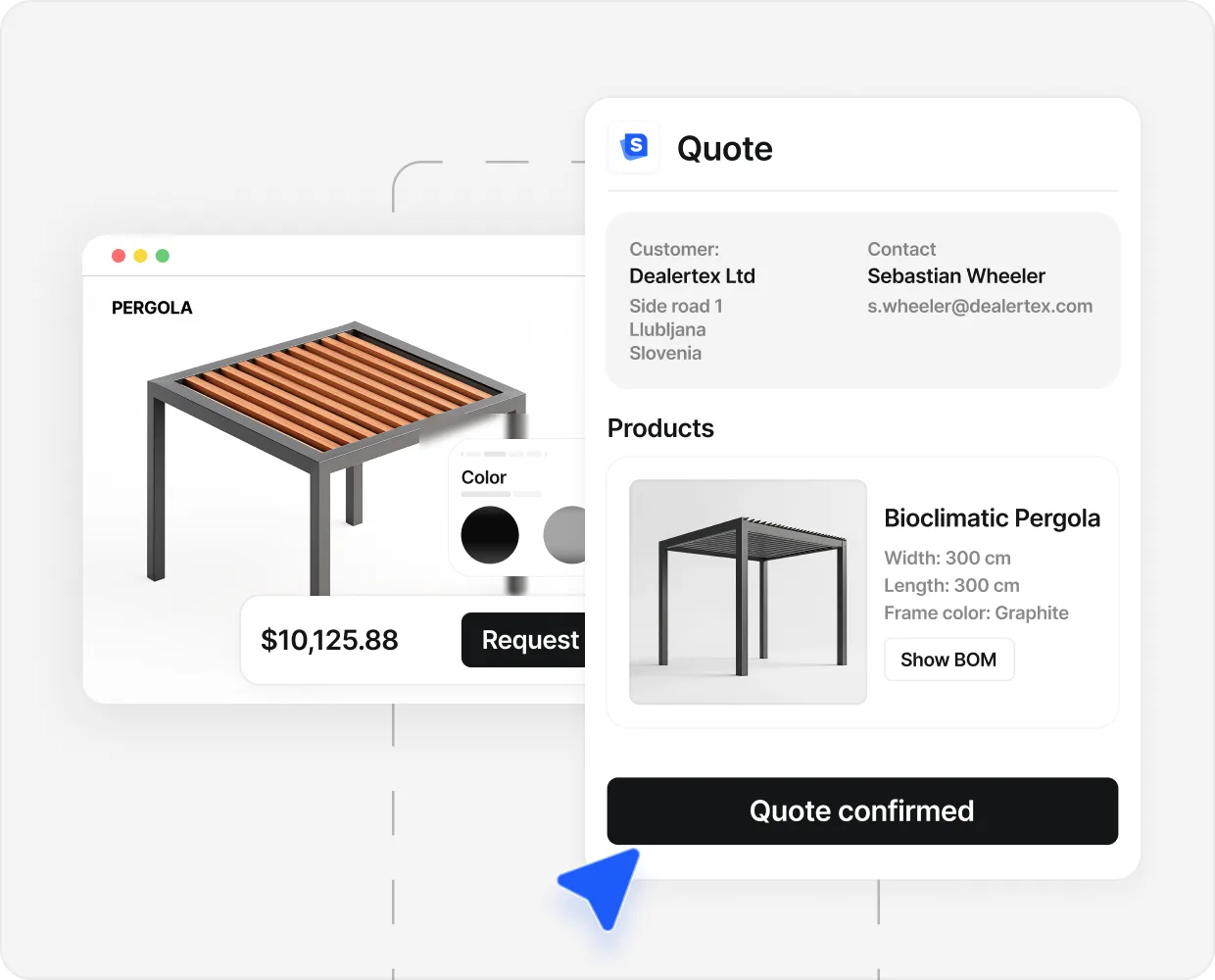
Now picture the same buyer on the same Saturday, on the couch at 11pm, on their phone. They open a website. They pick the pergola model. They set the size, the post finish, the roof type, the screens. They see the price. They get a designed PDF in their inbox before they close the tab. On Monday morning, the salesperson opens their inbox and sees the configured spec, the price the buyer saw, and how long they spent designing.
That second scene is the job of a digital showroom. The same showroom the salesperson would have run on a Saturday, except it ran while the salesperson slept, and it ran for every buyer who landed on the site that night, not one.
What a digital showroom replaces#
A physical showroom is not one thing. It is a stack of jobs that the buyer never names but always feels. The poster in the window that pulls them off the street. The shelf with the colour swatches. The expert behind the counter who walks them through the options. The fitting room where they hold the thing against their own context. The price tag. The contract. The follow-up call on Tuesday. The lights, the rent, the staff roster, the parking.
A buyer walks out of a good physical showroom and says “they sold it well.” A buyer walks out of a bad one and says “they didn’t really get what I needed.” What the buyer is grading, without knowing it, is the eight jobs above. A digital showroom is the same grade, on a different stage.
The mistake most people make is shipping a website and calling it a digital showroom. A website is a brochure. A 360 photo is a window display, on its own. An e-commerce checkout is a price tag and a cash register, on their own. None of those, alone, is a showroom. A showroom is the stack.
By Monday morning, 40 percent of our inquiries already came in as configured 3D quotes. The first conversation was different from day one.
Caribbean Blinds runs a pergola digital showroom that hits 508 leads in 90 days, with 40 percent arriving already configured. The number that matters in that story is not the 508. It is the 40 percent. Forty percent of inquiries arrive having already done the eight jobs themselves, on a screen, before a salesperson ever picks up the phone.
Eight jobs a digital showroom has to do#
Each one matters. Drop one, and the showroom is incomplete. A buyer who hits a gap (no price, no spec, no PDF, no follow-up) leaves and tries the next site.
The window display. A physical showroom catches the eye from the pavement. A digital showroom catches it from a Google search, a paid ad, a referral link. The hero image has the same job as the storefront window: tell the buyer in two seconds that they are in the right place. Get this wrong and the buyer never crosses the threshold. The bounce rate is the digital version of foot traffic walking past.
The product shelf. A physical showroom can fit two pergolas, four kitchens, six sofas. A digital showroom can fit every variant the factory builds. That is one of the biggest advantages, and one of the easiest to bungle. The product shelf is the catalog: the family of products, organised so a buyer who knows what they want gets there in two clicks, and a buyer who does not know what they want gets a guided path. The wrong shelf is a wall of SKUs with no story.
The expert at the table. The salesperson in a physical showroom walks the buyer through the choices, explains which roof type works with which post height, warns them about lead times, and answers the question behind the question. In a digital showroom, the configurator does this. Guided questions narrow the spec. Inline help text explains the trade-offs. The rule library blocks invalid combinations before the buyer hits a problem at the install. A digital showroom without rules is a digital showroom without an expert. The buyer specs the wrong thing and turns up at the install with a problem.
The fitting room. A buyer in a clothes shop holds a jacket against their shoulders in the mirror. A buyer in a pergola showroom mentally drops the louvered roof over their own back garden. A digital showroom does this with 3D. The buyer rotates the configured product, sees it in their colour, sometimes drops it on a photo of their own house. Without the fitting room moment the buyer never quite commits. They see a product. They do not see the product.
The price tag. A buyer reads the tag to find out if they are in the right neighbourhood. They do not need the final invoice. They need to know that the build they configured costs roughly what they expected and not three times that. A digital showroom needs a real number, not “starting from”, and not a contact form. A configurator that designs the perfect pergola and then says “we will get back to you with a quote” has failed the price-tag job. The buyer leaves and tries a site that prices live.
The contract folder. The physical showroom hands over a brochure, a hand-written quote, sometimes a signed deposit slip. The digital version is the designed PDF, branded, with the spec line by line, the price, the lead time, and the terms. It is the moat against the slower competitor. Two days later, when a slower vendor sends a handwritten quote, the buyer already has a designed document on the desktop with the right logo on it.
The follow-up. A good salesperson rings the buyer on Tuesday. A digital showroom does this through the CRM handoff and the automated email cadence. The configured spec lands in the salesperson’s pipeline with intent scoring. The buyer gets a polite series of emails answering the questions they did not ask in the configurator. Skip the follow-up and the showroom turns into a one-way broadcast. The buyer designs, hits send, and never hears back, because the spec landed in an inbox no one watches.
The infrastructure. Rent, lights, staff roster, parking, the alarm code. None of it shows up in copy, all of it has to work. The digital version is the hosting, the speed, the mobile load time, the accessibility, the ad tracking, the schema markup, the analytics. Most of it is invisible to the buyer right up until it is not. A digital showroom that takes eight seconds to load on a phone is a showroom with the lights off. A buyer who shows up to a dark showroom does not knock.

Eight jobs. The interesting thing is that the buyer never thinks “is this site doing the window display job well?” They feel it as a yes or a no. They scroll. They configure. They commit. Or they bounce, and they go to the next site.
What a digital showroom is not#
Three confusions show up in every category and they all break the same way: someone ships one piece of the stack and calls it a showroom.
It is not a 360 degree photo. A 360 photo is a window display, at best. It shows the buyer one finished product, from every angle. It does not configure. It does not price. It does not generate a PDF. A 360 photo is a single-product brochure that spins. A useful piece of furniture in a digital showroom, by all means. Not the showroom.
It is not a virtual store with avatars. Virtual showroom platforms in fashion and watches sometimes load a 3D space, drop an avatar in it, and let the buyer “walk around”. It looks impressive in a demo and rarely converts. The buyer does not want to walk a virtual aisle. They want to design a pergola and find out what it costs. A digital showroom is a job-to-be-done, not a metaverse field trip.
It is not an e-commerce checkout. E-commerce sells stock-keeping units. A buyer adds a known item to a cart and pays. A digital showroom sells configured products where the final price depends on size, finish, installation modifiers, and sometimes a site survey. The end of the showroom journey is usually a quote and a conversation with a salesperson, not a credit card swipe. The two can sit next to each other (some customers do checkout for accessories and quote for the main build) but they are not the same thing.
It is not a website with a contact form. This is the most common confusion. A site that shows photos of pergolas, a phone number, and “contact us for a quote” is a brochure with a doorbell. The buyer cannot design. The buyer cannot see a price. The buyer leaves a phone number and goes back to scrolling. The website has none of the eight jobs, and a digital showroom needs all of them.
How do digital showrooms differ from traditional showrooms#
The jobs are the same. The shift pattern, the staffing, the floor space, and the buyer behaviour are very different.
Hours. A traditional showroom runs office hours, sometimes six days a week, maybe a late Thursday. A digital showroom runs at 2am on a Tuesday. Roughly half of outdoor living traffic, by our reading of the analytics across the configurator gallery, arrives between 9pm and midnight on the buyer’s phone. A physical showroom that ran the same hours as a digital one would need a night-shift roster.
Capacity. A traditional showroom hosts one or two buyers per salesperson at a time. A digital showroom hosts every buyer who lands on it, at once, in parallel. The marginal cost of one more buyer in a digital showroom is roughly zero. The marginal cost of one more buyer in a physical showroom is another staff member.
Floor space. A traditional showroom can display two or three products at full size. A digital showroom can display every product the factory builds, in every finish, at full size, on a phone. The cost of stock display in a digital showroom is a few megabytes per model.
Cost per visitor. A physical showroom has a fixed cost (rent, staff, lights) and a fixed visitor capacity. Cost per visitor goes down as traffic goes up, but stops at the capacity ceiling. A digital showroom has a fixed cost (the tool, the hosting) and effectively unlimited capacity. The cost per visitor falls indefinitely.
Who does the work. This is the biggest difference, and the least often discussed. In a traditional showroom the salesperson configures, prices, and explains. In a digital showroom the buyer does all three, in front of a screen, before the salesperson is ever paged. The salesperson walks into the conversation at the point the physical showroom would have called the workshop for a number. The first ten minutes of every deal are off the salesperson’s plate.
Buyer behaviour. A buyer in a physical showroom asks questions. A buyer in a digital showroom does not. They click. If the click does not produce the answer in two seconds, they leave. The cost of an unanswered question is silent. The salesperson never hears about it. The site analytics show only a bounce.
- 8 Jobs to copy Window display, shelf, expert, fitting room, price, contract, follow-up, infrastructure.
- 24/7 Opening hours Roughly half of buyer traffic arrives after 9pm local, on a phone.
- 0 Cost per extra visitor Capacity in a digital showroom is effectively unlimited; physical showrooms cap at staff count.
- 40% Of inquiries arrive configured Caribbean Blinds: 40 percent of pergola inquiries come in as 3D-configured quotes.
Numbers behind the digital vs traditional showroom comparison.
The right way to read the comparison is not “digital wins”. It is “a digital showroom is the only way to staff a showroom at 2am”. Most sales in pergolas, garden rooms, kitchens, and modular homes still close in person, often on a site visit, sometimes back in a physical showroom. What changes is what walks in. A buyer who has already designed and priced their build is a different conversation than a buyer with a phone number and a vague brief.
When you do not need one#
Categories that do not need a digital showroom (yet):
- Your sale is under 5,000 euros. The unit economics do not work. The tool, the ad spend, and the time to set it up will not pay back from one extra closed deal. Below 5,000 euros the buyer journey is also usually shorter. A photo, a price, and a button is often enough.
- Your product is genuinely one-of-one. If every project starts from a custom CAD drawing with no repeatable spine, there is nothing to encode. The buyer cannot configure something that does not exist as a configuration. Stay with the conversation, charge for the design phase, treat the website as a portfolio.
- You have no website traffic. A digital showroom is a conversion layer. Without traffic, it is a model nobody sees. Spend the first six months on a usable site, on getting found in local search, and on running real ad spend. Then look at the showroom.
- You sell only through a marketplace. Etsy, Amazon, Wayfair, Houzz, a third-party dealer floor. A digital showroom lives on a domain you control. If you do not have one, that is the first thing to fix.
- Your buyers are 100 percent referrals. Some specialty cabinetry shops and architect-facing studios run on word of mouth, do not advertise, and quote in person. A digital showroom is overkill until the buyer mix shifts. The day a referral pipeline thins is the day to revisit.
The fit for a digital showroom is roughly: a category with a small set of repeatable configurations, an average sale above 5,000 euros, and a website that already has, or could plausibly have, real buyer traffic. Outdoor living, kitchens, modular homes, cabinetry, saunas and spas, garage doors, fences. Anywhere the buyer is configuring a built product, the showroom converts.
What a good one looks like on a Monday morning#
Before, Monday opens with a list of contact-form lines. “Interested in your pergolas, please call.” Twenty of them across the weekend. Half are price-shoppers. Two are serious. You do not know which two. You spend the morning calling, leaving voicemails, asking what people want.
After, Monday opens with twelve configured PDFs. Each one shows the product the buyer built. The size, the options, the finish, the price. The CRM already has the spec. You can see which buyer spent twelve minutes designing and which one bounced in thirty seconds. You call the first set. You let the second set sit. You quote nobody from scratch because nobody is asking you to.
That second Monday is the practical signal of a digital showroom that works. Not the demo on the homepage. Not the 3D model spinning above the fold. The first ten minutes of every conversation are off your plate, every week, for every buyer who landed on the site.
The deeper category writeup, with the eight checks for picking a vendor and the five paths (premade, generic 3D, freelancer, in-house, do nothing), lives in the 3D product configurator overview. The pergola-specific cousin of this argument is in the pergola configurator guide. When the category is one you sell, the live configurator gallery is the fastest way to see eight different versions of the same eight jobs, running on real customer sites.
A digital showroom is not the future of buying. It is the present of how a buyer at 11pm on a Saturday already shops. The question is only whether the buyer finds yours, or the one belonging to the company that quoted them in seconds while you slept.
People also ask.
What is a digital showroom?
A digital showroom is the online version of a physical showroom. The buyer walks in through a browser, picks a product, configures it in 3D, sees the price, and walks out with a designed PDF and a real conversation queued with a salesperson. It does the same job a real showroom does, only at any hour, on any device, without a host.
How does a digital showroom differ from a traditional showroom?
A physical showroom shows one or two display units, runs office hours, hosts one buyer at a time, and costs rent. A digital showroom shows every variant the factory builds, runs around the clock, hosts every buyer at once, and lives on a website. The biggest difference is who does the work. In a traditional showroom the staff configures, prices, and explains. In a digital showroom the buyer does all three, in front of a screen, before the salesperson is ever paged.
What is a digital showroom and how can it help contractors?
For a contractor, a digital showroom is the part of the website where a homeowner or architect designs the build, sees a real number, and gets a designed PDF. It replaces the morning of price-shopper phone calls, the kitchen-table Sundays spent quoting, and the contact-form replies that say 'interested in pricing, please call'. Monday morning becomes a stack of configured quotes the team can act on, not leads to chase.
Is a digital showroom the same thing as an e-commerce store?
No. An e-commerce store sells stock-keeping units. A buyer adds a known item to a cart and pays. A digital showroom sells configured products where the final price depends on size, options, finishes, and installation. The end of a digital showroom journey is usually a quote and a conversation, not a transaction. The two can sit next to each other on the same site, but they answer different buyer intents.
Do I need 3D in a digital showroom?
Not for every category. A digital showroom needs visual configuration so the buyer can see what they are buying. 3D is the strongest version of that for outdoor living, kitchens, modular homes, and any built product where size and finish change the picture. For simpler categories (blinds in five colours, awnings in three sizes) 2D image swaps still pass for a visual showroom. The test is whether the buyer can see their actual configuration before they ask for a price.
Will a digital showroom replace the salesperson?
No. The salesperson stops doing the spec work and starts doing the work that closes deals. The first ten minutes of a conversation used to go on size, finish, and base price. A digital showroom takes that off the plate. The conversation that follows is about delivery, install timing, financing, and the parts of a premium build that a buyer wants a real person to walk them through.
How long does it take to build a digital showroom?
It depends on whether the underlying tool already knows the product category. A premade configurator for pergolas, garden rooms, kitchens, or modular houses can be live in 1 to 10 days because the models, rules, and pricing scaffolding already exist. A custom build from scratch for a new category typically quotes 3 to 6 months. Most outdoor living, cabinetry, and modular categories fall into the first bucket.
How much traffic does a digital showroom need to be worth it?
Roughly the same as any commerce surface. Below a few hundred relevant visits a month, the digital showroom sits idle and the spend on it dwarfs the return. Above that, the rough threshold is whether one extra closed deal in the year pays for the year of the tool plus the ad spend that drove the visits. For categories with an average sale above 5,000 euros, that math tends to clear quickly.