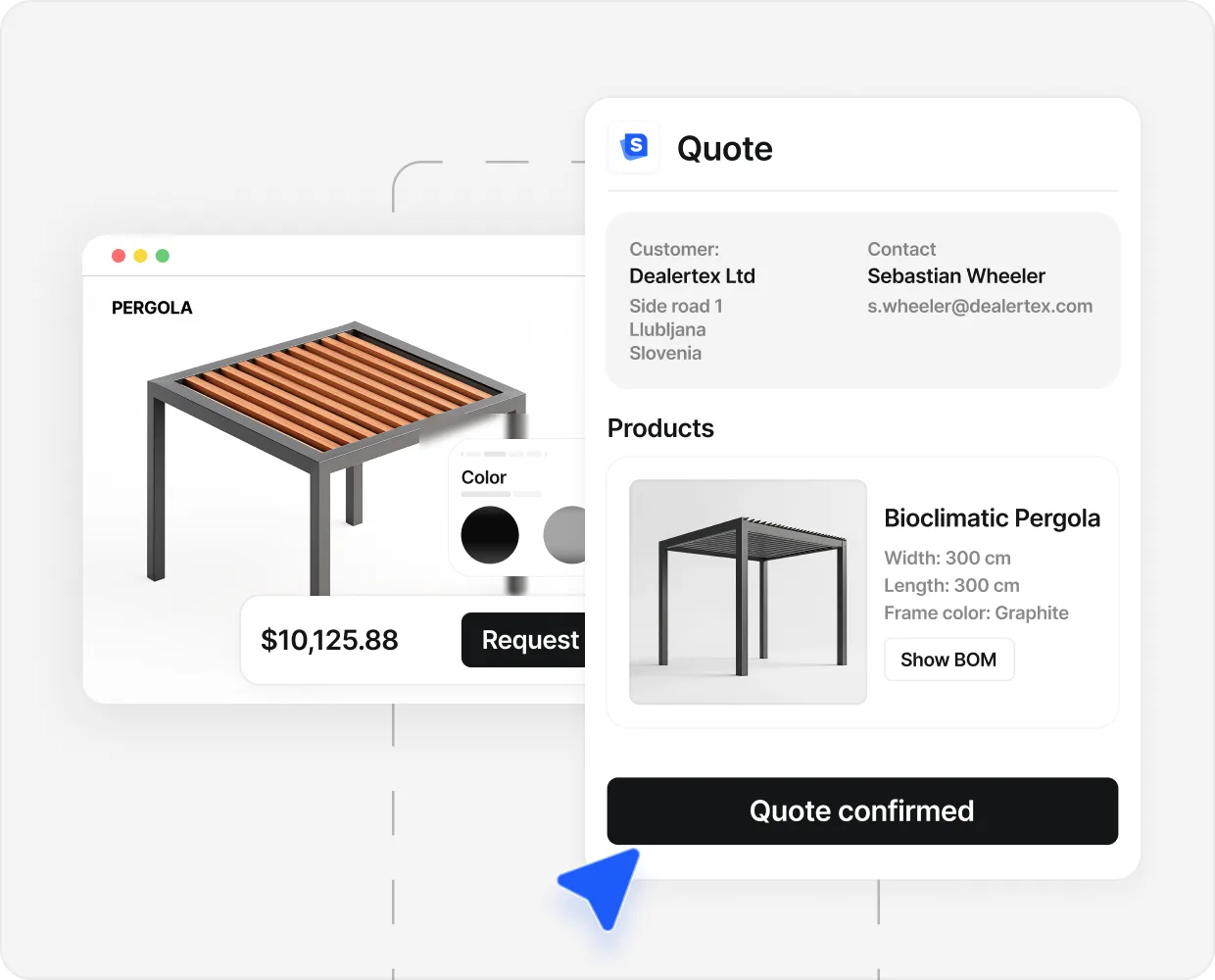


It is Tuesday afternoon. A pergola dealer has eleven weekend inquiries in the inbox. Two are serious, the rep does not yet know which, and by Friday only one will still be open. The rep called everyone, sketched the build on a notepad, sent the spec to engineering Wednesday, formatted the PDF Friday at 2pm. The buyer reads it Monday, having already signed with the company whose site let them design, price, and download a quote on Tuesday night.
The rep did everything right. The loop they were running took five days. The competitor’s loop took five minutes. This post is the sales-floor companion to why manual quoting errors are a structure problem: five things that go wrong between the discovery call and the signed deal.
Problem one: the quote arrives after the buyer has signed somewhere else#
The most common loss is a quote that was correct, professional, and three days too late. The buyer asked five companies for a price Monday. By Friday two had quoted. By the next Tuesday the buyer had signed and stopped reading new emails. The rep often does not know the deal is lost, since the buyer just stops responding, so the pipeline report still shows it open.
By Monday morning, 40 percent of our inquiries already came in as configured 3D quotes. The first conversation was different from day one.
Caribbean Blinds moved from days-long turnarounds to instant ones, with 508 leads in 90 days showing up priced. That is a sequencing story: the price arrived before the conversation, not after.
Problem two: the price changes between the first email and the final PDF#
This looks like a credibility problem when it is a working-memory problem. The buyer asks for a ballpark Tuesday, the rep says sixteen from memory. The engineer recalculates with current steel costs and comes back with eighteen-two. The rep sends the higher number Friday, and the buyer reads it as a bait-and-switch.
The rep was not wrong, they were reasoning from memory with the rule library nowhere in the room. The fix is that rep and buyer look at the same number on the same screen, computed by the pricing engine the moment the buyer changes a finish. Buyers do not negotiate against numbers the rep pulled from the air. That is a different conversation.
Problem three: the buyer cannot picture what they ordered#
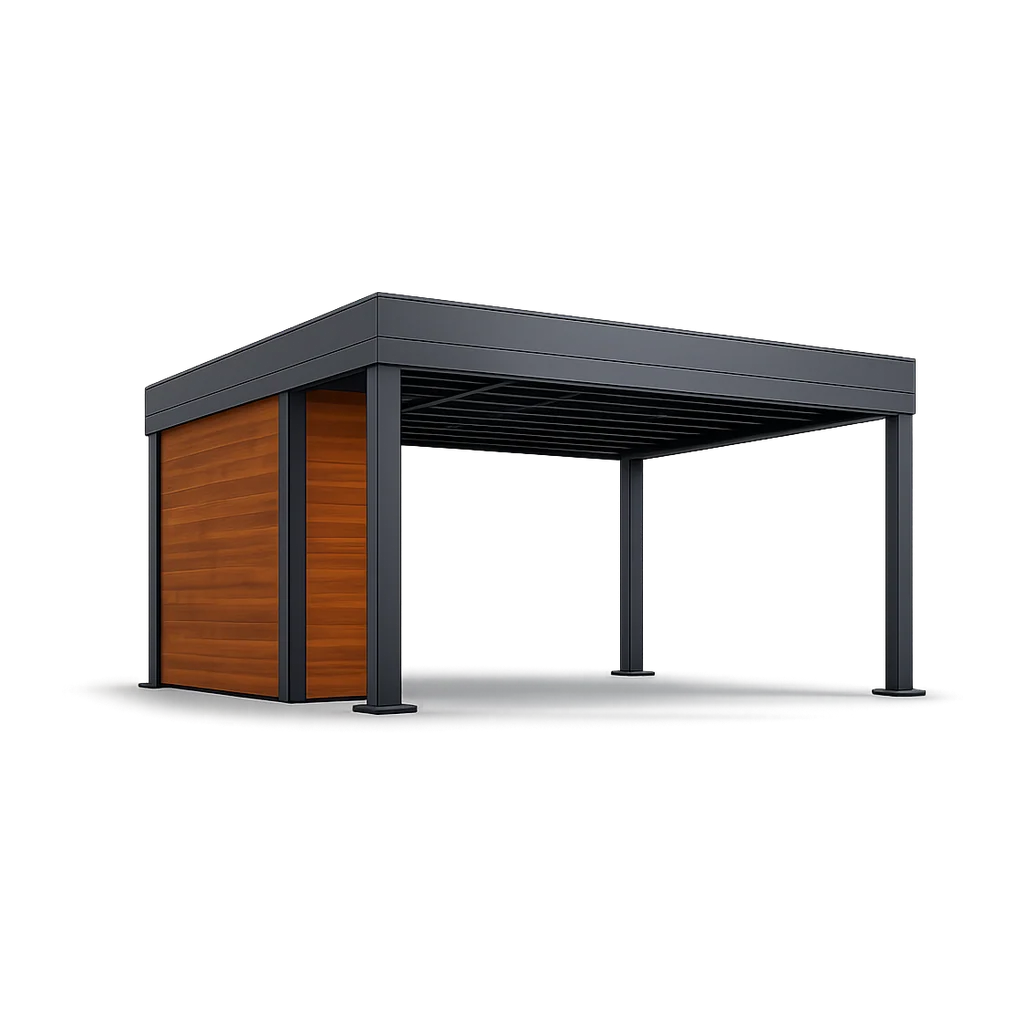
A made-to-order pergola is a thousand-line spec in trade language: five by four, 100mm post, anthracite RAL 7016, motorised louvre at 60mm slat. The buyer nods along, picturing something else. A week later they either change their mind when the render arrives, or get surprised on install day. Both kill the referral.
- 508 Leads in 90 days Caribbean Blinds (UK pergolas); 40 percent arriving as configured 3D quotes.
- 166 Hours saved over four months YourPergola (Hungary, louvred pergolas); 331 quotes generated with no extra headcount.
- 30 Pergola sales in 90 days Nordin (Lithuania); zero online presence before; 574 leads through the configurator.
- 10× Close rate vs industry Industry pergola close rate sits around 5 to 8 percent. Sellers running a configured funnel commonly land at 10 to 20 percent.
Public proof from the case studies. Numbers are sourced and unrounded.
When the buyer has built the product in 3D before the call, the conversation moves from description to confirmation. Across Caribbean Blinds, Nordin, and Spolding and Sons, visual buyers close faster and complain less.
Problem four: the rep cannot tell which leads are serious#
Out of twenty form submissions, two are real buyers, six are tyre kickers, the rest are curiosity. Reps burn Monday morning calling all twenty in submission order, leave fifteen voicemails, and book one real call for Wednesday, after the two real buyers have already signed elsewhere.
A contact form gives the rep a name and a one-line message, the same data a tyre kicker leaves. A configurator session leaves a different signal: the serious buyer spends twelve minutes designing and downloads the PDF, the tyre kicker picks the cheapest size and bounces in forty seconds. That signal is captured in serious buyer detection, sorting Monday’s leads by intent instead of submission time.
Problem five: every change becomes a new email thread instead of a new version#
The buyer wants the colour changed from anthracite to oak, a premium finish, so the new PDF comes back higher. The buyer asks for a middle option. By the end of week two, the inbox has four PDFs called v1, v2-final, v3-final-FINAL, and revised, and nobody is sure which is current. The buyer, still interested, goes quiet for ten days out of confusion rather than disinterest.
What changes is that the quote becomes a single live document. The buyer changes the colour themselves, the price updates in the same view, and the PDF is always the current one. Hrovat ran €133M of quotes through this loop and it scaled, because the loop was not constantly forking into version threads.
The five problems are one problem in five shapes#
Late arrival is slow quote production. Price drift is slow recalculation. No picture is the render that never happens. No signal is the qualification call that has to be made. Version chaos is reconciliation between drafts. Move the slow steps before the conversation, and the conversation becomes about closing instead of gathering, pricing, describing, qualifying, and reconciling.
For named numbers, Caribbean Blinds, Spolding and Sons, and Nordin are the shortest path from “this might work” to “this already works for a team like mine.” The live configurator gallery shows what these loops look like in production.
People also ask.
What are the most common quoting problems on the sales floor?
Five show up in almost every made-to-order team: the quote arrives after the buyer has signed elsewhere, the price on the PDF does not match what the rep said on the call, the buyer cannot picture what was described, the rep cannot tell which leads are serious, and every change becomes a new email thread instead of a versioned quote. These are timing and tooling problems, not skill problems.
Why does the quote arrive too late so often?
Because the rep is not the bottleneck, the engineer is. The rep takes the call Tuesday, hands the spec to engineering Wednesday, gets a number Friday, sends the PDF Monday. By then the buyer has had a second conversation with someone whose configurator priced the build live on Tuesday.
Why does the price change between the first email and the final PDF?
The rep ballparked from memory, the engineer recalculated from a spreadsheet, and the two numbers do not match. The buyer reads the gap as a bait-and-switch. Automation removes the guess: the rep and buyer see the same number, computed by the same engine, in the first conversation.
How do I know which leads are serious without calling all of them?
Watch what they did before they submitted. A serious buyer spends twelve minutes in the configurator and downloads the priced PDF. A tyre kicker spends forty seconds and bounces. That behavioural signal lives in the configurator session, not in the form fields.
Will automating my quoting process replace the salesperson?
No. It moves the rep's work from spec-gathering and quote-formatting to closing buyers who arrive with a configured build and a price they have already seen. Armat added 40 percent of revenue in three months with no new hires. The bottleneck was never the salesperson.