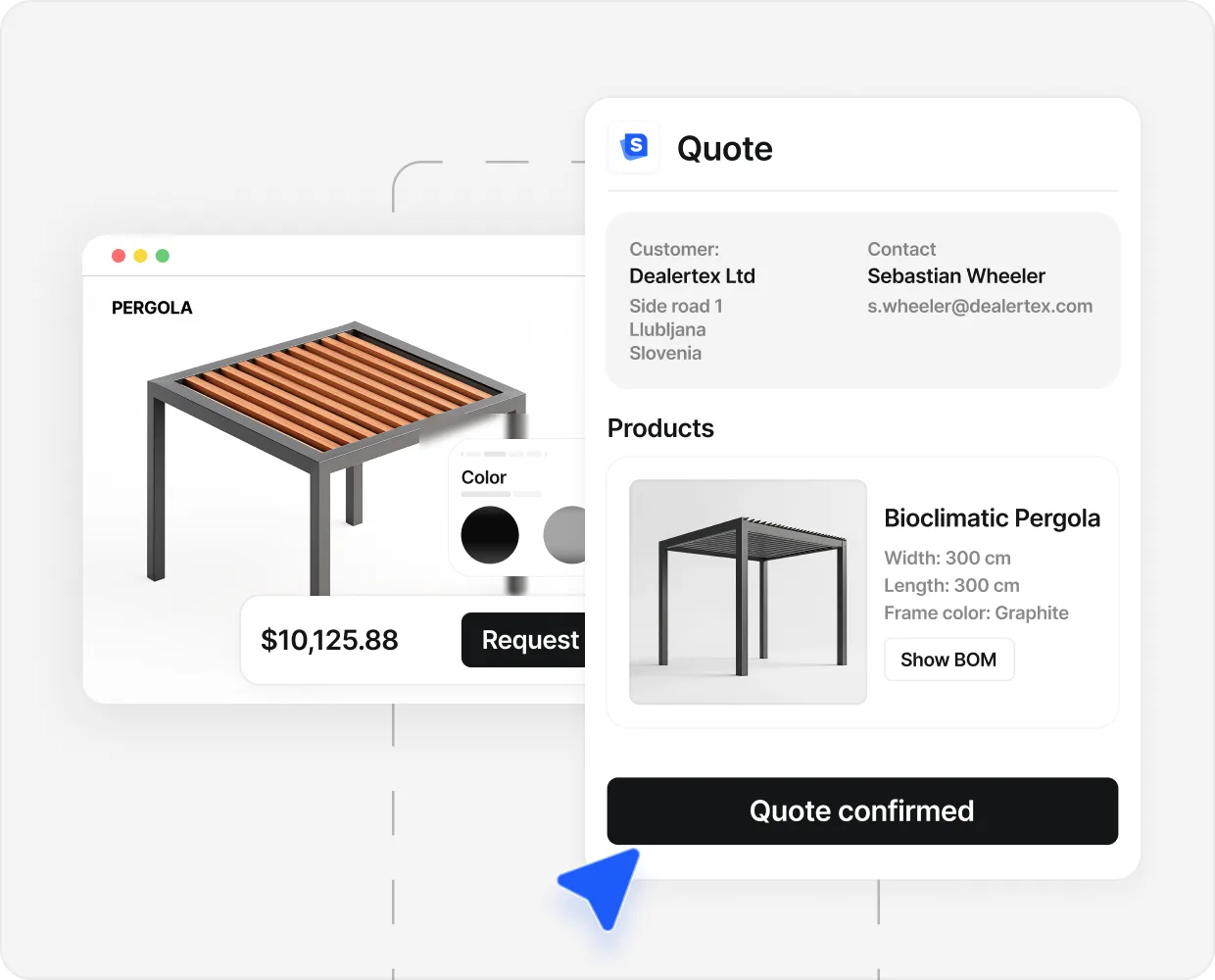


A dealer is standing on a buyer’s deck in early 2026 with a tape measure and a phone. The buyer wants a pergola in anthracite, motorised, side screens, 4 by 3.5, mounted to the house. The dealer has sold the line for six years but is not sure the screen colour is allowed at that post height in that finish. The dealer calls the factory. The line is busy. The dealer leaves a voicemail, promises a price by Tuesday, and drives back to the showroom.
On Tuesday the factory comes back: the combination is not certified. The buyer is short on the call, and by Wednesday has booked a measure with a competitor who uses a tablet on the deck, builds the spec live, watches the rule library refuse the invalid combination, swaps in a compliant alternative, prices the build, and emails a designed PDF before leaving the driveway. The buyer signs on Thursday.
We stopped training dealers on the rule library and started shipping the rule library into the tool. The dealers we worried about most became our fastest closers inside a quarter.
The two dealers above sell for the same factory. What decides which wins is not product knowledge or effort. It is whether the rules sit in a brochure on the passenger seat or run on the tablet, on the deck, in front of the buyer.
What dealer enablement is really trying to fix#
The dealer network exists because the factory cannot put a salesperson on every deck. The bargain breaks when the buyer asks a question only the factory can answer, and the dealer becomes a middleman in a conversation the buyer expected the dealer to lead.
Most programs read that gap as a knowledge problem and ship a thicker brochure or a longer training day. None of that changes what happens at the point of sale. Human heads do not hold 200-combination rule libraries reliably. They hold the last twenty deals. Anything outside that range needs a phone call.
The fix is to stop asking the dealer’s head to be the rule library. Put the rule library in software the dealer runs in front of the buyer. The dealer’s head goes back to reading the room and closing.
The 3 jobs a brochure cannot do#
Configure. The dealer builds any valid spec in front of the buyer without phoning the factory. Change the post height and the available roof types update. Pick anthracite and the certified screen colours filter automatically. The tool refuses to let an invalid build leave the deck.
Price. The price quoted on Tuesday is the price the factory honours on Friday. In a brochure-led world, the dealer eyeballs the price list, applies a regional modifier from memory, and either eats the gap when the factory invoice is higher or quietly inflates the next quote. A configurator wired to the factory’s cost engine prices the build the same way the factory would, every time.

Prove. The dealer shows the buyer the product, in something close to the buyer’s setting, before committing to a build. A 3D render of the exact spec, against the buyer’s own photo, does the job a brochure photo of somebody else’s pergola never could. Visual selling collapses the loop that brochure-led networks built quote-revision queues to manage.
The three jobs only earn their keep together. A configurator without pricing leaves the dealer eyeballing. Pricing without configuration leaves the dealer quoting builds the factory will not honour. Visuals without rules shows the buyer something the factory cannot make.
What changes when each job is wired in#
Caribbean Blinds, a UK pergola company, watched 40 percent of all inquiries arrive as configured 3D quotes from the dealer network the first quarter after rollout: 508 leads in 90 days, with the dealer network doing the heavy lifting at the point of sale.
Mizarstvo Hrovat, a Slovenian garden-room and modular-house manufacturer, ran a 30-month rollout across Slovenia and DACH: €133M in quotes through dealer-run configurators, 415% more inquiries, 10,835 hours of factory-coordination time recovered. The factory’s role changed from quote desk to support desk.
Impol, a Slovenian fence manufacturer, saw inquiry volume move from 50 to 700 a year, a 14x lift, on the same pattern: the configurator did the translation work, the dealer carried the conversation.
- €133M in quotes generated by the dealer network Mizarstvo Hrovat (Slovenia / DACH); 30-month rollout of dealer-run configurators across garden rooms and modular houses.
- 40% of inquiries arrive configured Caribbean Blinds (UK, pergolas); the dealer network delivers the priced 3D quote, not the contact form.
- 14x lift in inquiry volume Impol (Slovenia, fences); 50 to 700 inquiries a year after the dealer enablement layer replaced the brochure-and-callback workflow.
- 10,835 factory hours recovered Hrovat; time that used to go into per-quote dealer coordination, freed for production planning.
Named numbers and the full stories live in the case studies.
Across all three, the volume change gets the headline, but the structural change matters more: the factory stops being the quote desk, and the buyer never has a reason to call the competitor.
When training still beats tooling#
The deal is genuinely architectural. Every order is a one-off requiring an engineer’s assessment. There is no stable rule library yet.
The sales motion depends on a soft-skill moment the tool would interrupt. A homeowner choosing a 60,000-euro modular extension is not signing on the first visit. Pull the tool out at the third meeting, once the buyer is ready to commit a spec.
The product line is changing weekly. A factory still iterating on the line will rewrite the rule library faster than dealers can adopt it. Wait until the line stabilises.
For the categories that survive those filters, which is most of made-to-order outdoor living and modular construction, the three-job pattern is the difference between a network that backstops the factory and one the factory backstops.
The shortest path to running the three jobs in your own network is to pick the one product line where dealers phone the factory most, ship a configurator for that line, and roll it to two dealers in week one. Watch how many calls came in to the factory’s quote desk before and after. If the number drops by half, the rest of the network will pull the tool out of your hands.
People also ask.
What does dealer enablement mean for complex products?
It is the work of making a dealer fluent enough in your configuration rules, prices, and visuals that the dealer can quote a buyer without phoning the factory. For a configurable category, that fluency cannot come from a brochure. What works is wiring the rules into a tool the dealer runs in front of the buyer.
Why doesn't a brochure work for complex products?
A brochure is a list of options and a price list. For a product with 200 valid combinations and 40 invalid ones, that is a quiz the dealer takes in front of the buyer. The fix is shipping the rules into the dealer's workflow so the wrong combination cannot be quoted.
What are the 3 jobs dealer enablement has to do?
Configure, price, and prove. Configure means the dealer can build any valid spec without phoning the factory. Price means the price quoted is the price honoured. Prove means the dealer can show the buyer the product before committing to a build.
How does a dealer enablement tool protect the factory's margin?
It prices from the factory's cost engine, not the dealer's memory, so margin holds across every dealer. It runs the regional modifiers so cost cannot get quietly absorbed. And it logs every quote, so the factory can see which dealers are quoting at the floor and which at the ceiling.
What is the simplest first step for a small dealer network?
Pick the one product line dealers phone you about the most, and ship a configurator for just that line. Roll it out to two friendly dealers in week one. Measure how many factory phone calls came in before and after.