

Blog lead qualification

How to qualify remodeling leads before they hit the sales floor

Qualification is not BANT recited at the buyer. It is a pre-call filter that lets serious remodeling projects through. The four filters that catch 90 percent of bad-fit leads, and the order they run in so Monday opens at the closing question.

A remodeling project manager reviewing a clipboard of intake notes, working through buyer details before the first sales call.

A Monday in early 2026. A remodeling team in a market town opens its inbox to 20 weekend contact-form fills. Each one is some shape of “interested in a kitchen refit, can you call to discuss”. On a good week, five of those are real projects with a budget, a decision-maker, and a start date inside the year. The other fifteen are some mix of price shoppers comparing three quotes, homeowners “looking at options” for a project two years out, tenants who do not own the property, and a few who confused the form with a quote calculator. The salesperson does not know which is which until 30 minutes into the first call.

That gap, between the form fill and the first useful sentence, is where qualification lives. Done right, it happens before the team ever picks up the phone. Done wrong, the team spends half the week running discovery calls on conversations that were never going to close.

Monday used to be triage. We would block out two hours to call every weekend fill, work out which ones were real, and try not to insult the ones that weren’t. Now the inbox shows up sorted. The first call opens at “you have designed a 16 square metre office, when can we visit”, not “tell me what you are thinking”.

A garden room maker after moving from contact form to configured intake, in a 2026 onboarding review

The shift in that quote is what this post is about. The mechanism is a four-filter intake that runs before a salesperson sees the lead. The filters are not new. The order is. Budget reality first, then decision-maker presence, then project scope, then timeline. Visible price band at the top. The buyer reveals fit on their own terms, in their own flow, without anyone asking them to “describe their project in detail”.

The 4 filters that catch 90 percent of bad-fit remodeling leads#

The four filters are not a script. They are four moments in the buyer’s flow where fit gets revealed without the buyer being asked to perform fit. The order matters more than the wording.

Filter 1, budget reality. A visible price band, attached to the configuration the buyer is building, before any form is filled in. Not a “starting from” footnote at the bottom of the homepage. A real number tied to the real spec the buyer is designing. If a 4 metre kitchen run with mid-range cabinetry and a stone worktop lands in the £18,000 to £22,000 band, the buyer sees that number as they pick the worktop, not after they have sent an email. The buyer who walks at the band walks at minute one. The buyer who stays has accepted the order of magnitude, which is the most expensive thing a salesperson would have done on a discovery call.

Filter 2, decision-maker presence. One question, plainly worded. “Is the person buying this you, you and a partner, or someone else (a landlord, a developer, a parent)?” The wrong answer is not a disqualifier. It is a signal the team uses to decide what kind of conversation to have. A renter or a property manager forwarding to a landlord is not a bad lead. They are a different lead, and the follow-up cadence has to match. The point of the question is to stop the team running a 45 minute consultation with someone who does not have the authority to say yes at the end.

Filter 3, project scope. Two or three structured questions about what the buyer is trying to remodel: which room, what the rough size is, whether it is a fresh build or a refit, what the existing surface looks like. Not an essay box. A few scoped multiple-choice options that catch the out-of-category requests (the buyer wanting a loft conversion on a kitchen contractor’s site, the buyer wanting a £4,000 budget on a £40,000 premium product, the buyer in a region the team does not serve). Out-of-scope projects get a polite “we do not handle that, here is a directory of people who do” before they cost anyone an hour.

Filter 4, timeline. “When do you want this finished” with three options: within 3 months, this year, just researching. The third option is not a disqualifier. It is a signal to route the lead into a slower nurture sequence rather than the salesperson’s call list. “Just researching” buyers convert eventually if the team stays in touch by email. They do not convert this week, and pretending they do is what makes Monday’s call list useless.

Run those four filters in that order and roughly 90 percent of bad-fit traffic is sorted before a salesperson opens the inbox. The remaining 10 percent gets sorted on the call, which is the only place where the nuance (a renovation with a structural complication, a buyer between two products) needs a human in the loop.

Why a contact form qualifies the wrong things#

A contact form is built to maximise capture. Name, email, “tell us about your project”, submit. The friction is set as low as possible because the assumption is that every visitor is worth talking to. For lead-generation in a low-margin commodity category that assumption holds. For remodeling, where every conversation is a 30 to 60 minute interview followed by a site visit, it fails.

The contact form qualifies on the wrong axes. It captures intent (“the buyer was interested enough to type their email”), which is a weak signal across categories. It does not capture budget, authority, scope, or timeline, which are the four things the salesperson needs to decide whether to invest the hour. The team gets the email but has to recover the qualifying signal on a call, which is the work the form was meant to save.

The second failure is selection. A contact form selects for buyers who are willing to fill a form to find out a price. That is the population least committed to the spec, because the buyers who already know what they want skip the form and call a competitor. The form is filtering for indecision, which is the opposite of the signal the team needs.

Across roughly 160 customers running configured intakes against prior contact-form baselines, the pattern is consistent. Form-to-call conversion sits around 5 to 8 percent at the median, and “tire kicker rate” (leads that the salesperson immediately recognises as bad fit) commonly runs 20 to 30 percent, sometimes higher. One garden room dealer told us “half my leads are just price shopping, and I cannot tell which half until I have already booked the call”. The form did its job, in the literal sense. It just shifted the qualification cost from the funnel to the salesperson’s calendar.

What a self-qualifying intake looks like (with a visible price band)#

The intake is a short flow, three to six steps, that the buyer sees in place of (or just before) the contact form. The exact shape changes by category. The structure does not.

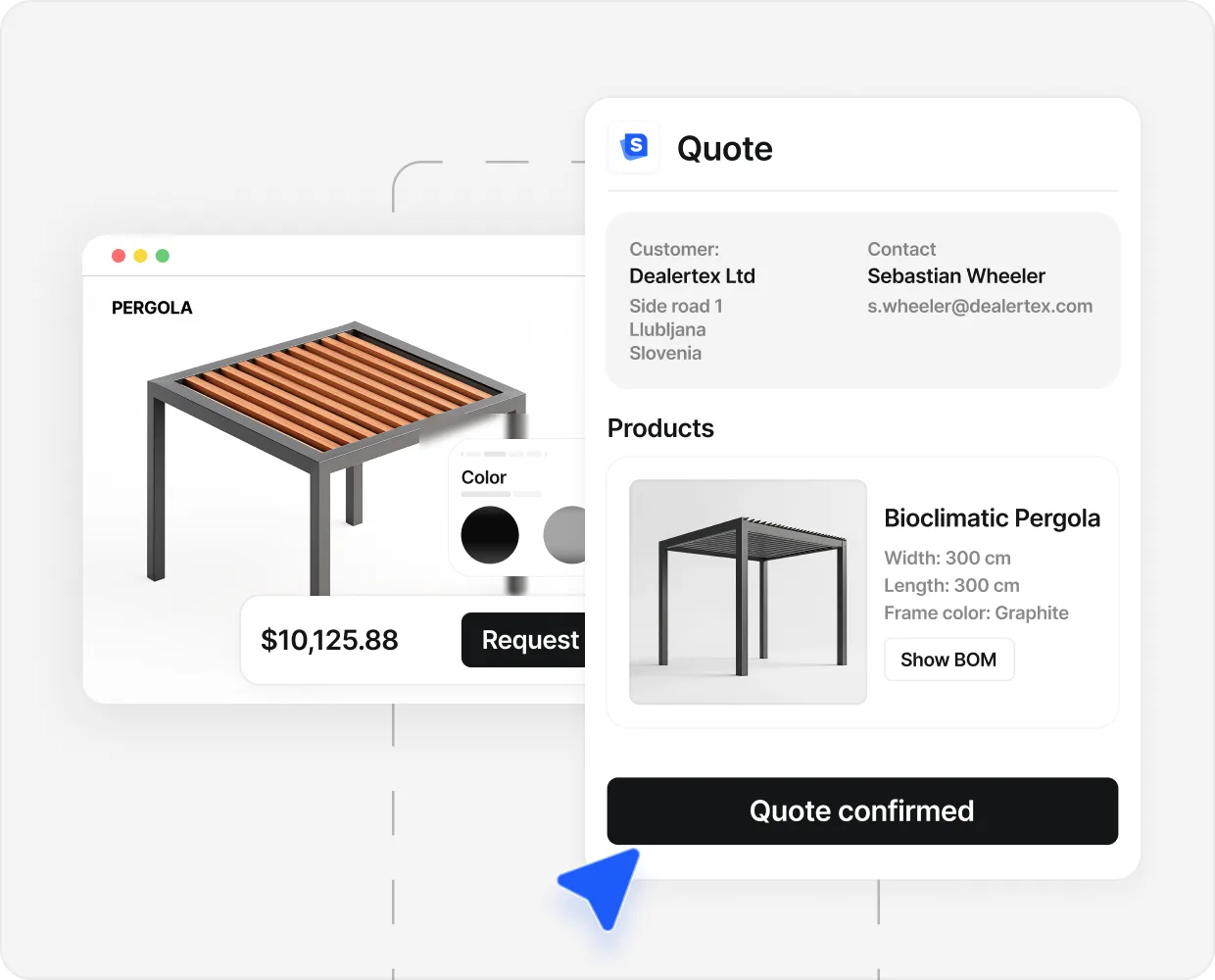
Step one is a scope chooser. What are you remodeling? A list of categories the team serves, with photos. Out-of-category clicks get routed to a polite “we do not handle that, here is who does” screen. Step two is a configuration moment. Pick the size, the level of finish, the major options. As the buyer picks, the price band updates live. Step three is the budget reality test. The band is now visible. If the buyer keeps going, they have accepted the order of magnitude. If they leave, the team did not lose a sale. They lost a discovery call.

A homeowner couple working through a remodeling intake at the kitchen table, talking over a floor plan and a printed configuration before contacting a contractor.

Step four is the decision-maker question. One line, three options (me, me and a partner, someone else). Step five is the timeline question. Three options (within 3 months, this year, just researching). Step six is the contact form, with the configuration already filled in. The buyer who reaches step six has passed all four filters and arrived with a configured spec, a budget band they have seen, a confirmed decision-maker, a project that fits the team’s scope, and a timeline the team can plan against. The salesperson opens that lead at “let me confirm the install window”, not “describe your project”.

Spolding and Sons shipped this pattern on a UK garden-room product. The numbers are public: 475 qualified leads in 12 weeks, an 8 percent landing-page conversion rate, £168K in new sales, 3x the previous sales rate at the same headcount. The configurator did the four-filter work in the buyer’s browser. The team’s inbox showed up sorted on Monday. The win was not the lead volume. The win was the deal density per call. Impol, a Slovenian fence manufacturer, moved from 50 inquiries a year to 700 (a 14x jump) on the same playbook in an adjacent category, with one person still handling the inbox. Same mechanism, same shape of result. A configured intake with a visible price band qualifies the lead before the team ever picks up the phone.

A Lithuanian outdoor product seller (Nordin, the case study sits in the customer roster) put it bluntly during a 2026 onboarding review: “50 percent of buyers said, in effect, I just wanted to know the price, thanks.” The configurator filtered them out. The team did not lose 50 percent of their sales. They lost 50 percent of the conversations that were never going to close, and recovered the time to run the ones that would.

  1. 475 qualified leads in 12 weeks Spolding and Sons (UK, garden rooms); 8 percent landing-page conversion and £168K in new sales at 3x prior sales rate, same headcount.
  2. 14× lead flow, 50 to 700 per year Impol (Slovenia, fences); one person still handling the inbox, quote prep cut from 1 hour to 5 minutes per lead.
  3. 20–30% tire-kicker rate, contact forms Industry composite across remodeling categories; share of inbound web leads the salesperson recognises as bad fit on the first call.
  4. 50% self-filtered out at the price band Nordin (Lithuania); buyers who left the configurator at the visible band were the conversations the team did not have to run.

Named numbers and the longer stories sit in the case studies linked above.

The trade-off: filtering hard loses some real buyers#

The honest version of the four-filter playbook includes the cost. A hard filter rejects some real buyers along with the tire kickers. Three patterns hold across the customer base.

First, the rejected buyers are mostly at the margin of fit. A buyer who walks at a visible £14,000 band on a 4 metre kitchen run was not going to close at the full margin. They were going to negotiate, ask for a discount, compare three other quotes, and either drop or land at a price the team would have wished they had walked from. The filter catches them at minute one of a configurator, not week four of a sales loop. The margin lost on the buyer who genuinely had the budget but wanted to think about it is real, and small.

Second, the volume saved on bad-fit conversations is the larger lever. A salesperson who runs 20 calls a week with a 5 percent close rate is at 1 closed deal. A salesperson running 8 calls a week at a 15 percent close rate (a typical post-filter number for outdoor living and remodeling) is at 1.2 closed deals, with 60 percent less time spent. The headline is not “more leads”. The headline is more leads worth working, as the outdoor living margin post lays out for the adjacent category.

Third, the lost-margin buyer often comes back. A homeowner who walks at a price band on a Sunday evening in March is the same person who returns in October with an actual project, a confirmed budget, and a partner ready to sign. The filter is not a one-shot door. It is a sorting mechanism, and the buyers it sorts out at the margin tend to either re-enter through the same flow when their project firms up, or land at a competitor where they renegotiate the price the seller is now defending against the team’s published band. Either way, the team does not lose the closeable share of the year.

The trade-off the team is making, in practice, is this. Fewer total leads, fewer total conversations, fewer total hours spent on calls, more closed deals, higher margin per close. The lost buyers at the margin are real, and they are paid for by the buyers the team keeps. The team that runs the filter aggressively and the team that runs no filter at all both end up in the same place in the long run. The difference is how much of the year the team spends on the phone with people who were never going to close. The four-filter intake is the bet that the salesperson’s hour is worth more than the contact form’s volume metric.

If you want the broader frame on what a self-qualifying buyer flow is (the four jobs it has to handle, the most common ways teams ship a flow that does not work), what guided selling is covers the buyer-side UX. If you want the contractor-side view of what the inbox looks like after the filter goes in, the Spolding and Sons case study is the shortest path from “this might work” to “this already works for a team like mine”.

The line to take home: qualification is not a script. It is a filter the buyer runs, in their own flow, before the team is ever asked to invest the hour. Four filters, in the right order, with a visible price band at the top. Run them well and Monday’s inbox shows up sorted. Run them badly and the salesperson spends half the week on conversations that were never going to close.

People also ask.

What does it mean to qualify a remodeling lead?

Qualifying a remodeling lead means deciding, before the first sales conversation, whether the project has the budget, the decision-maker, the scope, and the timeline to close. It is not a script the salesperson runs on a call. It is a pre-call filter built into the way the buyer arrives. The serious projects pass through and reach the team with a configured spec. The wrong-fit projects (no budget, no decision authority, wrong scope, or no timeline) get pushed back to self-service before anyone picks up the phone.

What are the 4 filters that catch bad-fit remodeling leads?

Budget reality, decision-maker presence, project scope, and timeline. Run them in that order. Budget reality means a visible price band before any form. Decision-maker presence means asking, plainly, whether the buyer signs the contract. Project scope is a couple of structured questions about what the buyer wants to remodel, so out-of-category jobs filter out. Timeline asks when the project starts: 'within 3 months', 'this year', or 'researching'. Together they catch most wrong-fit traffic before it costs anyone an hour.

Should I show price before qualifying remodeling leads?

Yes. The visible price band is the first reality test. A buyer who walks because the band is too high was never going to close, and they walk at minute one of a configurator instead of week three of a sales loop. A buyer who stays through the price band has already passed the most expensive part of the qualification work the team would have done on the phone. Hiding the number does not protect the deal. It just shifts the rejection conversation onto a salesperson, four days later, with a 30 minute call burned in the process.

Does pre-qualifying lose real buyers?

Some, yes. The honest framing is that any filter rejects a few real buyers along with the tire kickers. Two patterns hold across the customer base. First, the lost buyers are at the margin of fit (low budget, undecided, far-future timeline) and were never going to close at full margin. Second, the volume saved on bad-fit conversations more than pays for the lost margin buyers. Teams that move from contact form to filtered intake commonly see total revenue rise even when total lead count falls. The trade-off is in the post.

Is BANT still useful for remodeling leads?

BANT (budget, authority, need, timeline) is a useful checklist when written down on a planning page. It is a terrible script when recited at a buyer on a discovery call. The four filter framework is BANT reorganised so the buyer answers each question on their own terms, in the order that matches a real buying flow, with the price visible from the start. The names are different (budget reality, decision-maker presence, project scope, timeline) because the spirit is different. BANT is what the salesperson needs to know. The four filters are how the buyer reveals it without being asked.

How do I qualify leads from a contact form?

You mostly cannot. A contact form captures every visitor at the lowest commitment threshold. That is the wrong signal for qualification, because the buyer has done no work and revealed no fit. Two practical fixes: (1) add a small structured intake before the form (3 to 5 questions covering budget band, decision authority, scope, timeline), or (2) replace the form with a configurator that surfaces a price band as the buyer designs the project. Either way, the buyer who reaches the team has signalled fit. A bare contact form keeps filling the inbox with browsers.

At what volume of remodeling leads does pre-qualification start to pay off?

Roughly 25 inbound leads per month. Below that the salesperson has time to work every lead manually, and the cost of building a filter is hard to recover. Above that, every untriaged lead burns time the team could spend closing the qualified ones. The teams that benefit the most sit at 50 to 500 leads a month. Impol went from 50 to 700 inquiries per year with the same sales person because the intake handled the qualification work. Spolding and Sons ran 475 leads through the configurator across 12 weeks and closed £168K at 3x their previous sales rate, with no headcount added.

Start selling visually.

See SaleSqueze on your own product line.

Book a Demo
  • Live in 7 days
  • The build is free
  • Ready-made templates