

A buyer receives a quote on a Tuesday morning. The PDF is well-formatted, the price is in line with the market, the salesperson who sent it is good. By Sunday evening, the buyer is on the sofa with the email thread open, reading it for the third time. They have not replied. Monday will come, a “just checking in” note will land, and the buyer will not reply to that either. Two weeks later, the deal will sit in the CRM as “no response”, and the salesperson will tell the team it was probably the price.
It almost never is. We have watched this pattern across customer success calls with Nordin, Spa Solutions, and the rest of the customised-product portfolio, and the shape is consistent. A buyer who goes quiet is rarely refusing the number. They are stalled on one of four uncertainties, and the quote document did nothing to resolve any of them. The fix is a quote that pre-answers the doubt before the buyer has to ask.
We thought the price was scaring people off. Then we put the configured spec, the next step, and the install timeline on the same page as the number, and the reply rate on the same quote went from 22 percent to 58 percent. The price did not change. The doubt did.
This post is what those four uncertainties are, why more follow-ups makes the silence worse, what a quote looks like when it answers the questions before the buyer asks them, and the cases where a ghost is the configurator doing its job.
The 4 reasons a quote goes quiet (and what each one sounds like)#
The four show up in roughly the same proportions across pergola dealerships, garden-room builders, modular-house manufacturers, and saunas.
Spec doubt. The buyer is not sure they picked the right configuration. They liked the louvred roof on the website, but now wonder whether a fixed roof would have been smarter. The quote does not show them what their choice looks like, so they cannot test it against the picture in their head. Sounds like “I want to talk to my wife,” or “can you also quote me the other option?”
Next-step doubt. The buyer wants the product but has no idea what saying yes triggers. Is there a deposit, a site visit, a six-week wait? The quote ends with “let me know if you’d like to proceed”, which reads as “we will not tell you what proceeding means until you commit.” The buyer freezes.
Buying-group doubt. The buyer is not the only decision-maker. A homeowner needs their partner to sign off; a procurement officer needs the project manager to approve. The quote sits in the inbox because it cannot be forwarded as a clean artefact, useless to anyone but the original recipient. Sounds like “I need to discuss with the team.”
Seller-reliability doubt. The buyer believes the product is right but is not sure the team can deliver. The quote shows a price and nothing else: no install timeline, no warranty terms, no named references. The buyer drifts to a competitor whose quote arrived with a render and a written delivery commitment, and never tells the seller they walked.
The hard part is the four sound the same from the salesperson’s side. All produce silence. The salesperson reaches for the price, because price is the only variable the team can change in a hurry, and the deal closes around the wrong cause.
Why “send more follow-ups” makes ghosting worse#
The default playbook when a quote goes quiet is to follow up: one email at day three, another at day seven, a call at day ten, a final “I’ll close the file” at day fourteen. That advice is right for a busy buyer. It is wrong for an uncertain one, who needs more information, not a reminder.
The follow-up email contains a reminder and no information. The buyer reads it and thinks: this is the team I was about to give 12,000 euros to, and they cannot tell I already saw the first email. The team has just confirmed the doubt the buyer was already carrying. Worse, manual quoting errors that often accompany scrambled follow-ups, a price restated incorrectly, a missing line item, add a fifth doubt to the four.

The other cost: the sequence teaches the team to mistake activity for progress. Five emails across two weeks feels like work. None of them moved the deal, while the same hour spent rewriting the quote compounds across every future buyer.
What a quote looks like when it pre-answers the uncertainty#
The shape that consistently fixes the silence has four moves, one for each uncertainty, and none of them are clever.
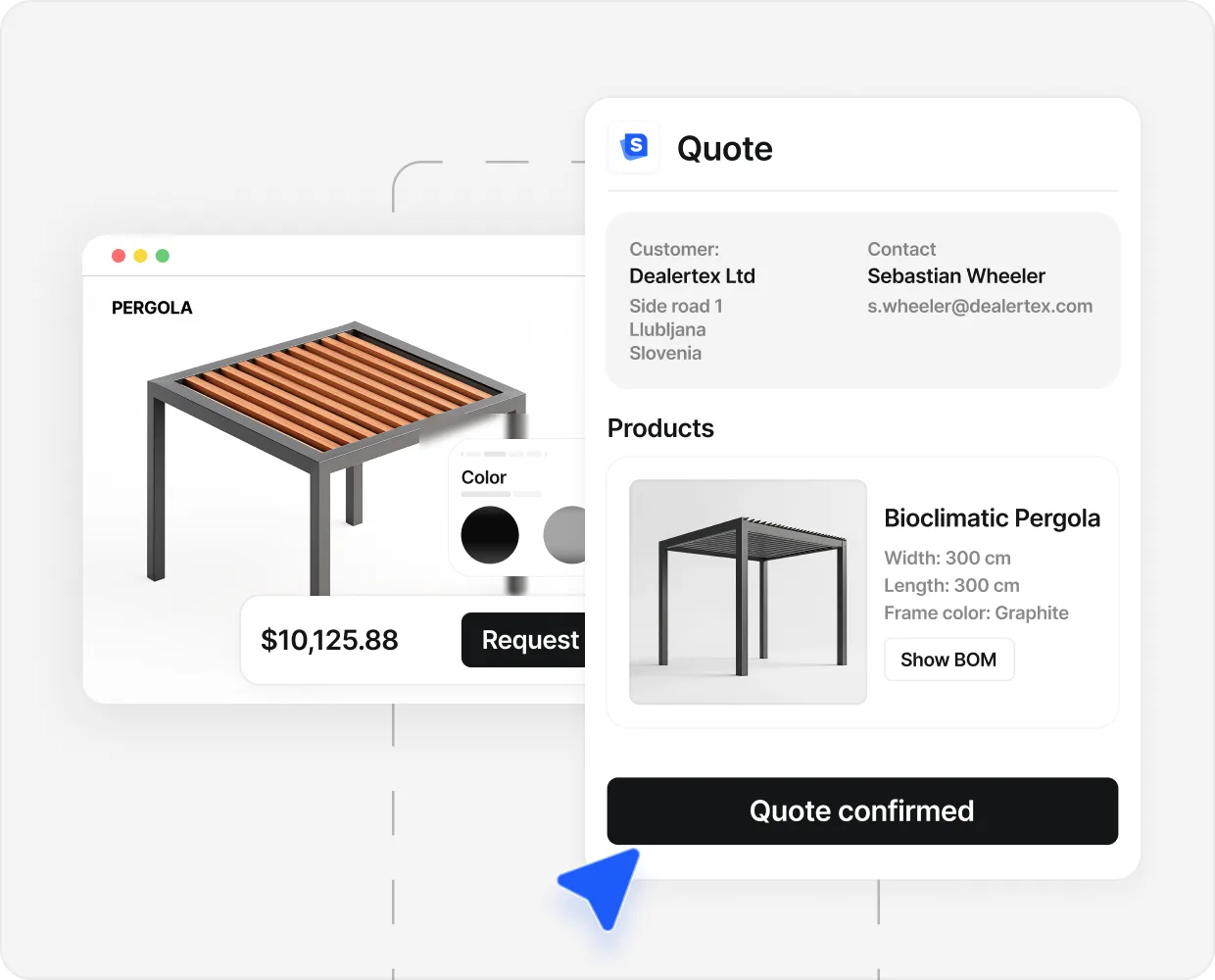
Show the spec they built. A 3D render of the exact configuration the buyer chose, not a generic catalogue image. Opening the PDF on Sunday evening, they see their own decision back at them, in their own dimensions, in the finish they picked. The spec doubt resolves the moment they recognise it. This is the last mile of the work the guided selling layer was set up to produce.
State the next step in one sentence. Not “let me know if you’d like to proceed”, but “if you confirm by Friday, we book the surveyor for Monday and the build starts week 6.” The buyer knows what saying yes does.
Make the quote sharable. The PDF opens with a one-paragraph summary a partner or procurement officer can read without context, then the visual, the price band, the next step, the proof.
Front the proof on the same page as the price. Two named customer references, the delivery timeline, the install team’s photo, the warranty in one line. None of it needs to be loud. It needs to be present.
- 50% of quiet buyers just wanted the price Nordin (Lithuania, pergolas); from a sales call after their first 30 sales in 90 days, the team heard about half of the silent buyers say plainly: I just wanted to know the price, thanks.
- 17% close rate in low season Spa Solutions (Switzerland, pergolas); 14 deals and €214K of revenue in a winter quarter, double the prior-year rate, after the quote was rebuilt to pre-answer the doubt.
- 5–8% average close rate Industry baseline for custom outdoor living and modular construction. Teams running configured funnels with pre-answered quotes typically land between 10 and 20 percent.
- 3 Follow-ups, then stop Past the third unanswered email, the lift from a fourth is roughly the same as the lift from rewriting the quote itself, and the rewrite compounds.
Numbers from public case studies and the customer success notes behind them.
When the ghost is a self-filter (and that is a good thing)#
Not every silence is a problem. When the quote is doing its job, a chunk of the buyers it goes to will read it, recognise the price is not for them, and walk away. That is the work the serious-buyer detection step was meant to do, the difference between a pipeline of 40 warm leads and one of 8 ready-to-close ones.
Nordin’s story is the cleanest example. The team built a configurator that resolved a configured spec, a price band, and a PDF for every visitor who completed it. About half of the buyers who went quiet, when reached, said the same thing on the phone: they had wanted to know the price, the configurator had told them, and that was the end of the question. The configurator filtered them out before the sales team spent a minute on them, and the time saved went into closing the buyers who stayed.
The team that learns to distinguish a stalled deal from a self-filter stops chasing the wrong buyers. The team that does not ends the quarter with a depressed close rate and a salesperson worn out by follow-ups that were never going to land.
If you are weighing where to start, start with the quote, not the follow-up cadence. Take the last 10 deals that went quiet and ask which of the four uncertainties those PDFs answered. If the answer is “none”, the rebuild is the work that earns the next quarter back.
People also ask.
Why do buyers go silent after receiving a quote?
Rarely because of the price alone. The silence is almost always a signal that the buyer is uncertain about one of four things: whether they picked the right spec, what happens after they say yes, who else has to agree, or whether the team that sent the quote can deliver. Each ghost has a specific fix, and none of them are solved by another follow-up email.
Is it always about price?
No. Nordin, a Lithuanian pergola seller, found that about 50 percent of the buyers who went quiet said the same thing on a follow-up call: I just wanted to know the price, thanks. Price was the gate, not the objection. Most of the rest were stalled on spec confidence, household agreement, or trust in the seller.
How many follow-ups should I send before giving up?
Three, spaced over 10 to 14 days, then stop. Past the third unanswered email, the cost of pushing further outweighs the chance of a reply. The lift you would get from a fourth or fifth follow-up is roughly the same as the lift from changing the quote itself, and the quote change compounds across every future buyer.
What should I do differently before sending the quote?
Pre-answer the four uncertainties inside the quote itself. Show a visual of the configured spec, state the exact next step in one sentence, surface trust signals (delivery time, install team, warranty, named references) on the same page as the price, and make the PDF sharable for anyone else who has to sign off. The quote stops being a price and starts being a decision aid.
When is a ghost good news instead of a stalled deal?
When the buyer would never have closed. A price-shopper who walks at minute three saves the team weeks of follow-up. A buyer whose budget is half the floor price is doing qualification work the seller would otherwise have to do later. The right configurator filters those buyers out on purpose.