
How long a custom pergola quote should really take
A homeowner spends a Saturday evening pricing pergolas. She fills out three contact forms. At 11:14pm on Saturday, an automated response from a configurator-driven seller lands in her inbox with a 4 by 4 metre louvered aluminium pergola, a price band, and a calendar link for a Wednesday call. At 9:12am on Monday, the second seller emails to ask what her postcode is. At 2:47pm on Tuesday, 47 hours after the form fill, the third seller emails a hand-built PDF that is 8 percent cheaper than the first one. By then the Wednesday call has happened. The deal is closed.
The third quote was the best offer, in technical terms. It arrived second. In a market where the buyer is comparing three to five vendors in parallel, the second-best offer that arrives first beats the best offer that arrives third almost every time. The reason most pergola teams quote in days instead of hours is not laziness. The rule library that decides what pairs with what, at what price, with what parts lives in someone’s head, and that person has a queue. The fix is not to make the person faster. The fix is to move the rule library somewhere else.
The strangest part was waking up on Monday morning to leads that had already configured the product, picked a finish, and seen the price. The work I used to do before lunch on Monday had already happened on Saturday night, without me.
The rest of this post is what the honest turnaround numbers look like, why most teams still quote in days, what the 24-hour quote does on the page, and why the first 5 minutes matter more than the quote itself.
The honest turnaround numbers (and where the cliff is)#
The trade press and most pergola dealer websites still quote “1 to 4 business days” as a reasonable turnaround. That number is anchored to the workflow, not to the buyer’s clock. Public conversion research, summarised across more than a decade of inbound studies, lands on a consistent shape: response inside 24 hours converts at roughly double the rate of response at 48, and the rate halves again past 72.
- 24h the cliff Quotes inside 24 hours convert at roughly twice the rate of quotes at 48 hours. Past 72, the rate halves again.
- 5 min first-response window Caseyresponse 5-Minute Rule: leads contacted inside 5 minutes are 7x more likely to qualify than leads contacted in the first hour.
- 508 leads in 90 days Caribbean Blinds (UK pergolas), after collapsing quote turnaround from multi-day to instant. 40 percent of inquiries arrive already configured.
- 166 hours saved over four months YourPergola (Hungary, louvered pergolas), 331 configured quotes shipped across the same four-month window.
Public proof and benchmark numbers, unrounded.
The numbers point in the same direction. A team that hits 24 hours wins twice as often as a team that hits 48. A team that hits 5 minutes wins 7 times as often as a team that hits an hour. A team that hits instant wins the deal before the comparison shopping is over. The shape of the curve is steep, and most pergola teams are sitting on the wrong side of it.
Why most pergola teams quote in days, not hours#
The standard reason given for slow quoting is that custom pergolas are complicated. Each project has a unique site, a unique buyer brief, and a unique parts list. The work is hard, the explanation goes, so the wait is reasonable.
That is true in the trivial sense and wrong in the load-bearing one. A made-to-order pergola line carries thousands of valid configurations. Posts in two or three diameters, roof spans across half a dozen widths, motor options, screens, lighting, drainage, finishes. Each combination has compatibility rules, pricing logic, and a parts list. The rule library exists. It is stored in the wrong place. It lives in a senior engineer’s notebook, a procurement spreadsheet, a salesperson’s memory of last summer, and three versions of a price sheet that nobody has fully synchronised since the steel supplier changed its rates in March.
When a buyer asks for a quote, the team reconstructs the relevant slice of the library by hand, from those scattered sources, under deadline pressure. Each reconstruction is a multi-hour queue. The total turnaround is the sum of the queues, plus the queue of buyers in front of this one. The team can quote one buyer per engineer-hour, and the engineer has six other buyers waiting. The math comes out to 1 to 4 business days, every time, regardless of how hard anyone works. The manual quoting errors that pile up on top of the delay are a separate problem with the same root cause.
There is a second reason teams quote in days. The team genuinely believes the buyer is willing to wait. For a €40,000 commercial canopy project with a procurement officer, the multi-day quote is acceptable because the buyer is also waiting on internal sign-off. For a €10,000 residential pergola where the buyer is comparing five vendors on a Saturday evening, the multi-day quote is the deal walking out the door. The premium residential segment, which is where most pergola dealers earn their margin, has the shortest attention window and the highest comparison density. That is the segment where the cliff bites hardest.
What the 24-hour quote looks like on the page#
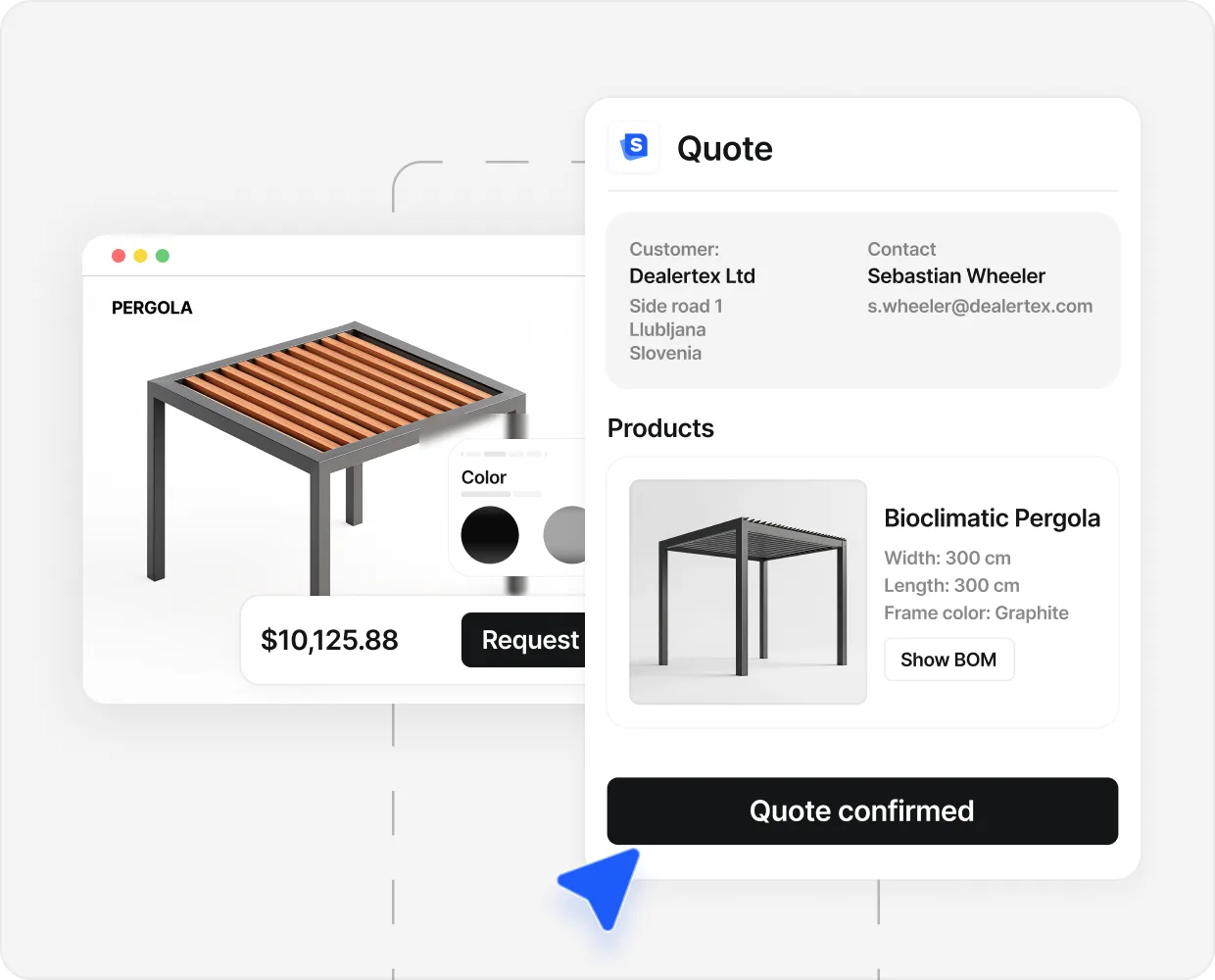
A 24-hour quote is not a faster version of the 4-day quote. It is a structurally different artefact. The 4-day quote is a PDF a salesperson produces by hand after a phone call. The 24-hour quote is a configured spec the buyer produces themselves, against a rule library that already knows the prices and the parts.
The shape of the flow, end to end, looks like this:
- 01
The buyer arrives at the site and sees a configurator, not a contact form. The configurator opens to a default product (4 by 3 metre louvered, in anthracite) so the first state is already a real thing.
- 02
The buyer adjusts size, finish, motor, screens, and lighting. Each choice fires the rule library, which filters incompatible options before the buyer can pick them.
- 03
The price band updates live as the buyer changes the spec. By the time the spec is fixed, the price is fixed too.
- 04
The buyer commits the configuration. The system writes a configured PDF, a 3D render, and a parts list, all from one source. The PDF lands in the buyer's inbox inside a minute.
- 05
A salesperson opens Monday morning to a queue of configured leads, each one with a 3D render, a price the buyer has already seen, and a self-qualifying signal that they wanted the product enough to spend 7 minutes designing it.
The salesperson is still in the loop. The change is what the salesperson is doing. Instead of gathering specs for the first call, they are closing on a configured one. The conversation starts at “walk me through how you designed the 4 by 5 in anthracite” rather than “what size were you thinking”. The compression of the qualifying conversation is the change, not the volume of leads.
This is the architecture that lets Caribbean Blinds hand 508 leads in 90 days into the pipeline, with 40 percent arriving already configured. It is the architecture that lets YourPergola ship 331 quotes over four months while reclaiming 166 hours of engineering time. Hausmart, an outdoor-living brand that automated its quote-to-cash flow end to end, runs the same play and cut its turnaround by 70 percent. None of these teams hired their way to the result. They moved the rule library out of someone’s head and into the system. Picking between a sales configurator and CPQ is a decision about which part of that library each tool runs.
The 5-minute first-response rule (and what it pays back)#
If the 24-hour rule sets the conversion cliff for the priced quote, the 5-minute rule sets the cliff for the first response. The two are different artefacts. The first response is whatever the buyer sees in the first 5 minutes after they fill out the form. The priced quote is the configured PDF that lands later. Both matter, and the curves are different.
In a manual flow, the first response is a salesperson on a follow-up call, which almost never happens inside 5 minutes because the salesperson has a queue. In a configurator-driven flow, the first response is the configured PDF itself, which lands inside a minute because the configurator and the PDF generator are the same system. The 5-minute rule is satisfied as a side effect of the architecture, not as a heroic effort on the part of a sales rep.
The payoff is the qualification gradient. Caseyresponse and the wider inbound-response literature put the gradient at 7x for the first 5 minutes versus the first hour, and 21x against the first 24 hours. The mechanism is two-part. First, attention: the buyer is on your site right now. Once they close the tab, the cost of re-engaging them is an order of magnitude higher. Second, comparison: the first vendor to respond gets the first slot in the buyer’s shortlist, and the shortlist closes faster than most sellers think.
The team-side payoff is the inverse of what most teams assume. The fear is that automating the response will degrade the conversation. The data points the other way. The salesperson on the eventual call gets a buyer who has already designed the product, seen the price, and self-qualified by spending 7 minutes in the configurator. The call is shorter, the close rate is higher, and the salesperson handles more deals per week without working more hours. The job that used to be “translate the buyer’s brief into a quote” becomes “close a buyer who has already done the translation”.
Most pergola teams treat the 5-minute window as an aspirational target that the SLA can never quite hit. It is not. It is what the architecture produces by default, the moment the rule library moves out of someone’s head and into the pricing engine. The change we ship at SaleSqueze is built around this collapse: the buyer’s configured spec is the auto-quoting trigger, and the same configured spec writes the BOM, the PDF, and the CRM record from one source. The 5-minute response is not an effort, it is a side effect.
The buyer on Saturday evening is comparing three vendors. The one who responds at 11:14pm on Saturday is the one whose architecture answered the question. The other two will respond on Monday, and one of them will be cheaper, and neither of them will close the deal. Quote turnaround is not a customer service metric, it is the architecture choice that decides which side of the cliff you land on.
People also ask.
How long should a custom pergola quote take?
Hours, not days. The honest target is a priced configuration the buyer can see while they are still on the site, and a follow-up call from a salesperson inside the same business day. The industry default of 1 to 4 business days is a workflow promise, not a buyer promise. Public conversion data shows quotes delivered inside 24 hours convert at roughly twice the rate of quotes delivered at 48, and a quote that lands after 72 hours is reading material, not a buying decision.
Why is 24 hours the conversion cliff?
Because 24 hours is the window in which a serious buyer is still in active comparison mode. Most pergola buyers evaluate 3 to 5 vendors in parallel. The first priced, configured response wins the first slot in the shortlist. The fifth response, two days later, is competing against a buyer who has already narrowed down. Past the 24-hour mark, the quote stops being a decision input and becomes a reference document.
What is the 5-minute rule for first response?
Inbound leads contacted within 5 minutes of submission are 7 times more likely to qualify than leads contacted an hour later, and 21 times more likely than those contacted after a day. The number comes from inbound-response research summarised by Caseyresponse and confirmed across most large-sample studies of B2B lead handling. The mechanism is attention: the buyer is on your site right now. Once they close the tab, the cost of re-engaging them is an order of magnitude higher.
How do top pergola teams turn quotes around in hours?
By removing the translation step. In a manual flow, the salesperson takes a brief, walks it to the engineer, the engineer recalculates pricing and parts, and the salesperson formats a PDF. Each handoff is a multi-hour delay. In a configurator-driven flow, the buyer configures the product, the rule library prices it in real time, and the PDF generates on commit. Caribbean Blinds replaced a multi-day cycle with an instant configured response.
Is instant pricing on a custom pergola realistic?
Yes, for any line where the configurations resolve to a finite rule library. A made-to-order pergola line typically holds 2,000 valid combinations. That fits comfortably inside a pricing engine. Each combination resolves to a price the moment the buyer fixes the spec. The number on the screen is a real price, not an estimate. The exceptions are genuinely bespoke architectural one-offs and projects with site-specific structural work, which still need a human in the loop.
What slows pergola quotes down the most?
The translation step between the buyer's request and the priced PDF. A typical flow has the salesperson interviewing the buyer for the spec, the engineer rebuilding the parts list, procurement checking current pricing, and the salesperson reformatting it into a presentable PDF. Each step is a queue, and the queues compound. The fix is not to make any one step faster, it is to remove the steps by letting the buyer configure the product directly against a rule library that already knows the parts and the prices.
Does faster quoting reduce margin?
No, and the data points the other way. Teams that move from manual quoting to a configurator typically see margin stabilise or improve, because the pricing engine pulls live cost data and applies the regional margin rule on every quote. Margin leaks in manual quoting come from outdated input costs and forgotten line items, both of which the configurator solves by construction. Hausmart cut quote turnaround by 70 percent and saw revenue grow, not margin shrink.