

It is Wednesday afternoon in a manufacturer’s office on the outskirts of a mid-sized European town. The rep has been at her desk since 7:30. The inbox shows 14 unanswered emails: spec questions from buyers she quoted last week, a sales engineer asking whether the 5 by 4 louvred pergola needs the 100mm post or the 120mm, price checks because the steel rate changed on Tuesday, and weekend leads waiting on a first reply. Full days, honest effort, and not a single fresh quote has gone out since Monday.
This is not a careless rep. The week looks like this because every artefact has to be translated from one format to another. The spec lives in the buyer’s head. The compatibility rules live in the engineer’s head. The current price lives in three spreadsheets last reconciled a week ago. The rep is the bridge between them, so most of the week is translation, not selling.
We thought we had a quoting problem. We bought software that promised faster quotes. The quotes got faster by maybe twenty percent. The week stayed broken. What fixed it was killing the Monday translation step, the Wednesday compatibility step, and the Thursday price step.
Salesforce State of Sales puts non-selling activity at roughly two thirds of a rep’s week. In customised-product lines, the bulk of that lives inside the quoting workflow, which is the polite way of saying it lives in the translation work on the way to the quote.
What 60 percent of a sales rep’s week really goes to#
Monday, the rep processes weekend contact-form submissions, each some version of “interested in a pergola, please send pricing.” She calls eight buyers, reaches three, spends 20 to 40 minutes per call extracting the spec. That is the intake loop.
By Wednesday, two of those buyers are back because engineering flagged a compatibility question. The compatibility loop: three or four hours.
Thursday is pricing reconciliation. The aluminium rate changed Tuesday. The rep recalculates three quotes and emails the workshop to confirm. Two to three hours, more during supplier-change windows.
Friday afternoon is the quote itself: format the PDF, double-check the parts list, attach the drawing, send. Ten minutes per quote, eight quotes, 80 minutes total.

Live buyer conversation with intent to close lands between 8 and 12 hours out of 40. The remaining 28 to 32 hours are translation work, and it is the structure of the work, not a personal failing.
Why “automate the quote” misses the real bottleneck#
Most vendors lead with quote-generation as the headline feature: auto PDFs, branded templates, one-click pricing. It lands because the quote is the visible artefact. But the math is unforgiving.
A quote that takes ten minutes manually, automated to ten seconds, saves ten minutes. On a rep producing eight quotes a week, that is 80 minutes: selling time moves from 10 hours to 11 hours 20. A three percent bump, real but not the improvement the rep was promised.
The quote is downstream. The spec still has to be gathered, the compatibility checked, the price reconciled. Faster quote generation saves ten minutes at the end while the upstream work sits untouched.
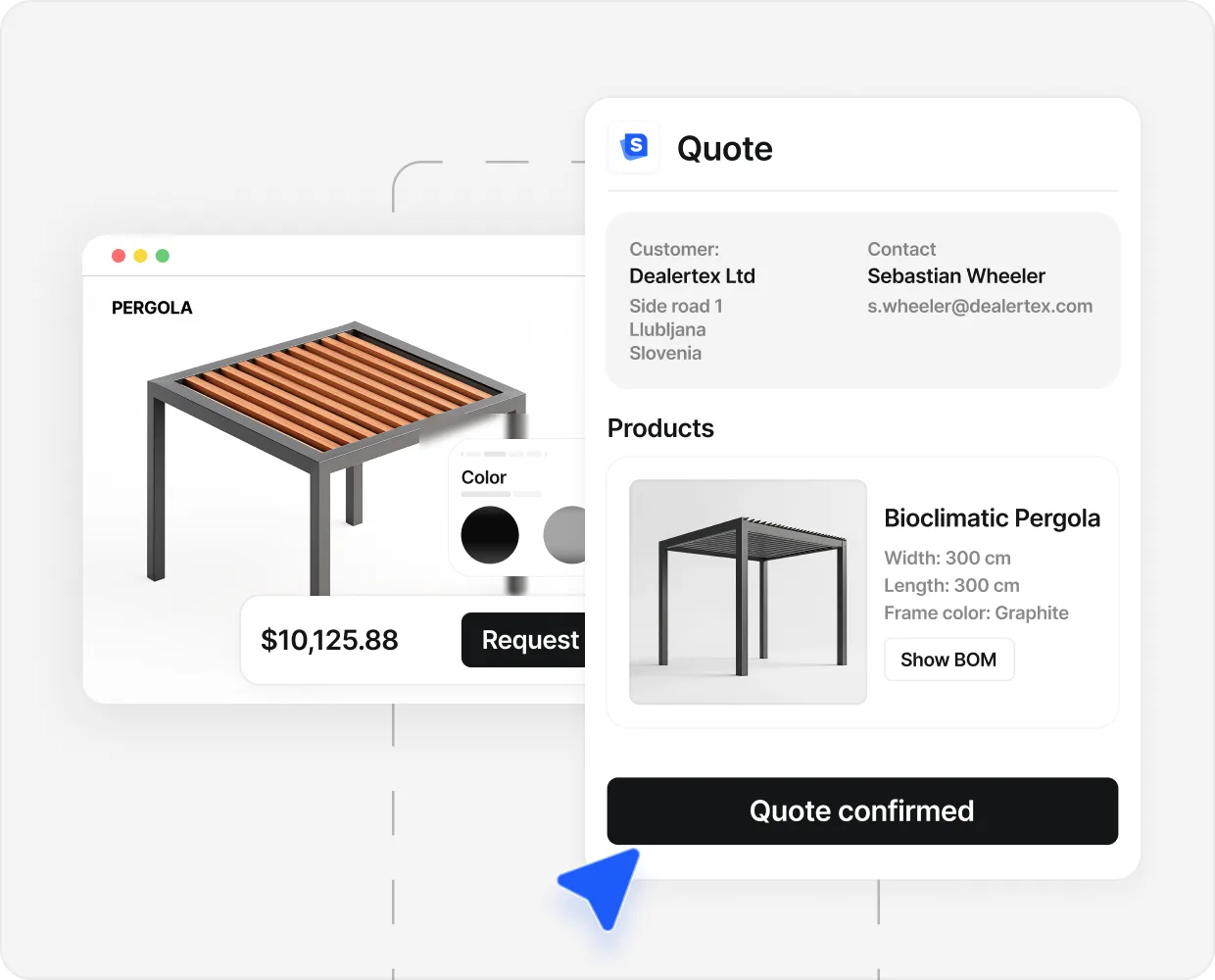
Hrovat sat with this honestly. The first pass put a configurator on the website and kept the manual workflow behind it: quotes got faster, the week stayed broken. The second pass moved the rule library into a configurable bill of materials wired to a pricing engine. Buyers’ choices arrived already structured and priced. The 10,835 hours saved came from killing the upstream loops, not a prettier PDF.
The 3 translation loops worth killing first#
Loop 1: spec intake. The Monday ritual of turning a contact form into a written spec, 20 to 40 minutes per call. The fix is a configurator on the public website where the buyer designs the product themselves. YourPergola ran the configurator alongside the rep on every call and recovered 166 hours across the team over four months.
Loop 2: compatibility clarification. The Wednesday ritual of explaining why the 5 by 4 roof needs the 100mm post. The fix is the same configurator, wired to the compatibility rules, so the 80mm post is simply unavailable in the menu. The deeper walkthrough lives in manual quoting errors.
Loop 3: pricing reconciliation. The Thursday ritual of checking whether Tuesday’s price still holds. The fix is a single pricing engine: the rate changes Tuesday morning, the new rate flows to every open quote by Tuesday afternoon, no human in the loop.
- 10,835 hours saved Hrovat (Slovenia, modular houses); €133M in quotes processed after the translation step was removed.
- +40% revenue in 3 months Armat (Slovenia, carports); 1,873 inquiries worth €12.3M, no new sales hires.
- 166 hours saved over four months YourPergola (Hungary, louvred pergolas); 331 quotes generated across four months with the same team.
- ~60% of the rep's week Translation work in customised-product lines, before the upstream loops are automated.
Named numbers from public case studies. The 60 percent figure is from internal diary studies plus Salesforce State of Sales.
What changes when the translation step is gone#
The rep’s day. Before, she arrives at 7:30 and starts intake calls. After, she opens an inbox of configured PDFs and goes straight to the close. The Wednesday clarifications never start. The Thursday reconciliation never happens.
The team’s pipeline. Before, the pipeline grows as leads come in and shrinks as the team works through the backlog, running even. After, the pipeline grows continuously because translation is no longer the rate-limiter. Armat lifted revenue 40 percent in three months with no new sales hires.
The headcount conversation. Before, the team debates hiring a third rep because the current two cannot keep up. After, the question becomes whether the existing team can absorb the next product line without growing. The structural argument for who needs which kind of tool sits in sales configurator vs CPQ.
The Friday quote is real, and it is also the smallest part of the cost. The 60 percent of the week that goes missing is upstream, in the three translation loops a person runs because the rule library lives in distributed human memory. Move the library into software, kill the loops, and the week reshapes around closing instead of translating. The named numbers sit in Hrovat, YourPergola, and Armat.
People also ask.
How much time does the average sales rep spend on quoting?
Salesforce State of Sales puts non-selling activity at roughly two thirds of a rep's week. In customised-product lines we have audited, the quoting and pre-quoting block alone runs 50 to 60 percent of working hours. The quote itself takes ten minutes; the work around it takes the rest.
What counts as the translation step in a quote?
Every step where a person turns an unstructured buyer signal into a structured artefact another system can read: the intake call, the engineering note, the price check, the PDF. Each can be done by software once the rule library exists.
Why does faster quote generation alone not fix this?
Because the quote is the last step, not the bottleneck. Shaving it from ten minutes to ten seconds saves ten minutes. The compounding savings only land when the upstream loops (spec intake, compatibility, pricing) are automated too.
What are the three translation loops to automate first?
Spec intake (replace the contact form and discovery call with a configurator), pricing reconciliation (move pricing rules from spreadsheets into a live engine), and engineering hand-off (resolve the bill of materials automatically on submit).
Does automation reduce headcount on the sales team?
In the lines we have watched, no. Armat added 40 percent of revenue in three months with the same team. What changes is what the rep does with the recovered hours: closing calls instead of spec intake, field visits instead of price reconciliation.