Comparison
Best product configurator software: 12 tools for made-to-order manufacturers
- 12 tools graded on 7 buyer criteria
- Customer-facing vs enterprise CPQ, mapped
- Named EU and UK proof, not vendor claims
Trusted by 160+ outdoor living pros



















What this page covers#
Search for the best product configurator software and the results blur together fast. Some of the tools are built for a homeowner to design a pergola on your website. Others are built for a sales engineer to price a six-figure machine inside SAP. They share a configuration engine, so they look like the same category in a roundup, but they solve different jobs for different buyers, and picking the wrong one is the difference between a 1-day launch and a 12-month rollout.
This page grades 12 product configurator tools for the made-to-order manufacturer: the team that sells a configurable physical product (outdoor living, modular buildings, fencing, cabinetry, furniture) and wants the buyer to configure, price, and request a quote before the sales call. If you are not sure which category you are even shopping in, start with the sales configurator versus CPQ guide and the longer read on CPQ software for manufacturing. Then come back here for the tool-by-tool map.
How to grade product configurator software#
Seven criteria separate the tools that close deals from the ones that only render a nice picture. Weigh them against your product and your buyer, not against a feature checklist.
Who configures: the sales rep or the customer#
This is the first fork, and it decides almost everything downstream. A rep-driven tool can assume the user is trained, patient, and logged in. A customer-facing tool has to teach a first-time visitor on a phone how to design a product they have never bought before. If your growth depends on people configuring on your public website, a tool built for internal reps will quietly collapse your conversion rate.
Time to launch: premade versus bespoke#
A premade configurator for a known category goes live in days because the template, the rules, and the 3D already exist. A bespoke build, whether from an agency or an enterprise vendor, starts from a blank canvas and runs months. The fastest way to waste a year is to commission a custom configurator for a product that already has a premade template waiting.
Visual fidelity matched to the product#
Match the rendering to what the buyer needs to see, not to what demos best. A five-figure outdoor structure earns real-time 3D configuration because the buyer wants to see the finish before committing. A simpler item converts fine in 2D. Photoreal rendering and AR are genuinely useful for furniture and retail catalogues, and overkill for a fence.
Does it produce a real priced quote#
A configurator that ends in a pretty model and a contact form has stopped one step short of the sale. The job is to produce a priced quote: the buyer sees the number, gets a branded PDF, and the deal moves. Automatic quoting tied to your cost rules is what turns a 3D toy into a sales tool.
How the configured spec reaches production#
The configuration only pays off if the spec travels. The bill of materials should resolve from the buyer’s selections, the priced quote should land in the CRM the moment they submit, and the production-ready spec should reach the ERP. Tools that stop at the render leave your team re-keying every order by hand.
Lead capture and marketing events#
Customer-facing configurators sit on the marketing surface, so they should fire events into your ad platforms and your CRM as the buyer designs, prices, and submits. That is how you retarget the buyer who configured but did not submit, and how the sales team gets a qualified record instead of a scratch form fill. Rep-driven CPQ was never built for this, because it sits behind the login. See how the integrations and dealer handoff close that loop.
Pricing and who the tool is built for#
Price tracks the buyer the vendor sells to, and it moves by an order of magnitude across the category. Per-seat ecommerce SaaS, per-seller trades subscriptions, low-five-figure custom builds, and six-figure enterprise CPQ are four different worlds. A tool priced for a 50-rep enterprise will not fit a regional manufacturer, and the reverse is also true.
The 12 tools, grouped#
The honest way to read this category is by who drives the configuration. The top group is customer-facing: the buyer designs on your website. The bottom group is rep-driven or engineer-to-order CPQ, where the configuration happens inside the sales motion. SaleSqueze sits in the first group and is not the right pick for the second.
| Tool | Who configures | Best fit |
|---|---|---|
| SaleSqueze | The customer, self-serve | Made-to-order trades selling on a public website |
| Configurix | The customer, self-serve | Outdoor-living dealers wanting a 3D configurator |
| Combeenation | Customer or rep | Teams wanting a horizontal builder with dev resources |
| Roomle | The customer, self-serve | Furniture and interior catalogues with CAD output |
| Zakeke | The customer, self-serve | B2C ecommerce stores adding personalisation |
| Threekit | The customer, self-serve | Ecommerce catalogues needing photoreal 3D and AR |
| Expivi | The customer, self-serve | Online retailers tying 3D config to checkout |
| Tacton | The sales engineer | Large industrial manufacturers, complex rules |
| Epicor CPQ | The rep or engineer | Engineer-to-order with CAD and shop-floor output |
| Configure One | The rep | Established manufacturers standardising quoting |
| Salesforce Revenue Cloud | The sales rep | Enterprise teams already on Salesforce |
| Elfsquad | The rep or customer | Mid-market makers of customer-specific machinery |
Customer-facing visual configurators#
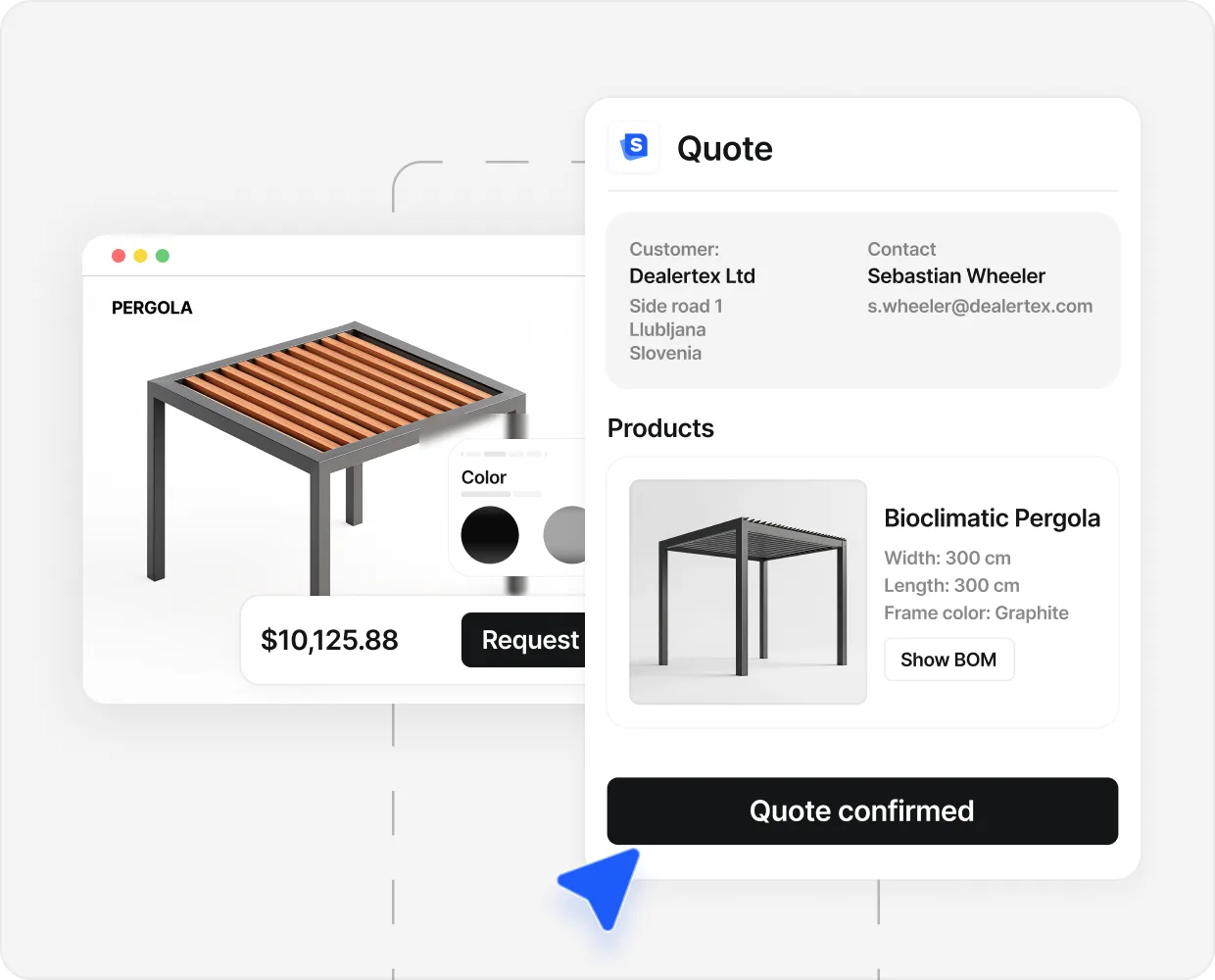
SaleSqueze. A customer-facing visual sales platform for made-to-order trades: outdoor living, modular buildings, fencing, and the long tail of configurable products sold through a website. Premade configurators go live in about a day, the buyer designs and prices on the public site, and the configured quote lands in the CRM with the bill of materials ready for production. Best fit: mid-market manufacturers and dealers who want the buyer to do the configuration work. The named proof is the differentiator, covered in the next section and in the live configurator gallery.
Configurix. A 3D configurator and quoting tool aimed at the same outdoor-living niche, with a pergola and veranda lean. Customer-facing and a close substitute for the trades buyer. Best fit: dealers who want a 3D configurator and are comfortable with a narrower template library.
Combeenation. A horizontal EU configurator (Austria) with a flexible builder that spans many industries rather than one vertical. Best fit: teams with developer resources who want a general-purpose configuration canvas and are willing to build the vertical logic themselves.
Roomle. A furniture and interior 3D configurator with a strong CAD pipeline and AR room placement. Best fit: furniture brands and interior catalogues where the room render is the product and the output feeds manufacturing CAD.
Zakeke. A visual product customiser that plugs into Shopify, WooCommerce, and other storefronts for print, apparel, and made-to-order ecommerce. Best fit: B2C ecommerce sellers adding personalisation to an existing online store rather than running a quote-driven sales process.
Threekit. Photoreal 3D and AR visualisation plus a configurator for direct-to-consumer, furniture, and retail catalogues. Best fit: ecommerce brands whose priority is catalogue imagery and try-on. Threekit projects commonly run around 90 days because each is built bespoke for the catalogue, which is the trade-off against a premade trades template.
Expivi. A 3D product configurator with headless commerce hooks. Best fit: online retailers who want 3D configuration tied directly to a checkout and an existing ecommerce stack.
Enterprise and engineer-to-order CPQ configurators#
Tacton. Enterprise CPQ for industrial manufacturing, with a deep rule engine, 3D, and CAD automation, usually deployed inside SAP or Salesforce. Best fit: large manufacturers of complex machinery selling six-figure contracts through trained sales engineers. The buyer does not configure a turbine on a website, and Tacton is built for the rep who does.
Epicor CPQ. Formerly KBMax, a visual CPQ for engineer-to-order that automates pricing, CAD drawings, and bills of materials through to the shop floor. Best fit: ETO manufacturers who need configuration wired directly to engineering output.
Configure One. A manufacturing CPQ from Revalize with two decades in complex configurable products. Best fit: established manufacturers standardising quoting across direct and channel sales, with the team to run an enterprise rollout.
Salesforce Revenue Cloud. The CRM-native CPQ (formerly Salesforce CPQ) for enterprise sales teams already standardised on Salesforce, with approval workflows and negotiated discounts. Best fit: rep-driven B2B motions. The buyer never configures; the rep does, inside the CRM.
Elfsquad. A manufacturing CPQ with self-service configuration, multi-level bills of materials, and CAD parameters, positioned as business-led rather than IT-led. Best fit: mid-market makers of customer-specific machinery and equipment that sit between trades and full enterprise.
What SaleSqueze brings to the category#
SaleSqueze is not the right pick for an ecommerce catalogue or a six-figure industrial sale. For the made-to-order manufacturer selling configurable products through a website, four things separate it from the rest of the list.
Premade, not bespoke#
The configurators are premade for known product categories, so they go live in roughly a day for a standard template and five to ten days for a tailored one, against the 90-day bespoke builds and multi-month enterprise rollouts elsewhere on this list. You can browse the working examples in the configurator gallery.
Built for the buyer to self-serve#
The buyer designs and prices on your public site, not a rep behind a login. At Caribbean Blinds, 40 percent of inquiries now arrive through the 3D configurator, and the team sees over 500 leads in 90 days. That only happens when the surface is built for a first-time visitor on a phone.
A priced quote and a bill of materials, not just a render#
The configuration resolves into a real priced quote and a production-ready bill of materials, then hands off to the CRM and the production floor. Hrovat, a Slovenian garden-room and modular-house manufacturer, has run 133 million euros in quotes through the configurator and saved 10,835 hours of manual quoting. The render was never the point. The handoff was.
Named proof across verticals#
The results are named and spread across the made-to-order map, not a single demo vertical. Spolding and Sons tripled sales on 475 leads, FollHaus booked 10 million euros of pipeline in its first month, and Impol went from 50 to 700 inquiries a year. The full set sits in the customer stories.
When SaleSqueze is not the right fit.
Common questions.
What is product configurator software?
Product configurator software lets a buyer or a sales rep assemble a customisable product from valid options, see it update visually, and get a price. The better tools also produce a quote and pass the configured spec downstream to the CRM and the production system. The category splits into customer-facing configurators that the buyer drives on a public website, and rep-driven CPQ that lives behind a login.
What is the difference between a product configurator and CPQ?
Same engine, different door. CPQ (configure, price, quote) is internal software a sales rep logs into to price complex B2B deals. A customer-facing product configurator exposes the same job on your public website so the buyer configures and prices themselves before the sales call. The deeper line-by-line read is in our sales configurator versus CPQ guide.
What is the best product configurator software for small or made-to-order manufacturers?
If you sell a configurable physical product (pergolas, garden rooms, fencing, modular buildings, furniture) to homeowners, contractors, or trade buyers through a website, a customer-facing configurator built around premade templates will fit better than enterprise CPQ. It goes live in days rather than months and the buyer does the configuration work themselves. Enterprise CPQ fits when a rep must price six-figure industrial contracts.
How much does product configurator software cost?
Three rough bands. Customer-facing configurators run a per-seller subscription, with premade templates at the low end and custom builds in the low five figures. Ecommerce visual customisers are per-seat SaaS. Enterprise CPQ implementations commonly run six figures in licensing and integration with six to eighteen month rollouts. See our pricing page for the SaleSqueze model.
Do I need a 3D configurator, or is 2D enough?
Match the fidelity to the product. A buyer choosing a louvred pergola finish or a garden-room cladding wants to see it in 3D before committing five figures, so 3D earns its keep. A simpler made-to-order item with a handful of options can convert on a clean 2D configurator. The trap is paying for photoreal rendering you do not need while skipping the quote and CRM handoff that actually closes the deal.
How long does it take to launch a product configurator?
It depends entirely on premade versus bespoke. A premade configurator for a known product category, like pergolas or garden rooms, can go live in one to ten days. A bespoke 3D build from an agency or an ecommerce visualisation vendor commonly runs 90 days or more, and enterprise CPQ runs six to eighteen months. Time-to-live is the single biggest cost difference between the categories.
Can a product configurator integrate with my CRM and ERP?
A serious one should. The point is that the configured spec and the priced quote land in the CRM the moment the buyer submits, and the bill of materials pushes into the ERP for production planning. A configurator that only renders a pretty model, without writing the spec into the systems your team already runs, is half a tool.
Related comparisons.
Start selling visually.
See SaleSqueze on your own product line.
By clicking “Book a Demo” you agree to our Terms of Service and Privacy Policy.
- Live in 7 days
- The build is free
- Ready-made templates